It runs and runs
Continuous or near-continuous cycling with no obvious inflow. Most often a check valve letting the discharge column fall back into the pit: the same water, over and over, until the motor gives up.
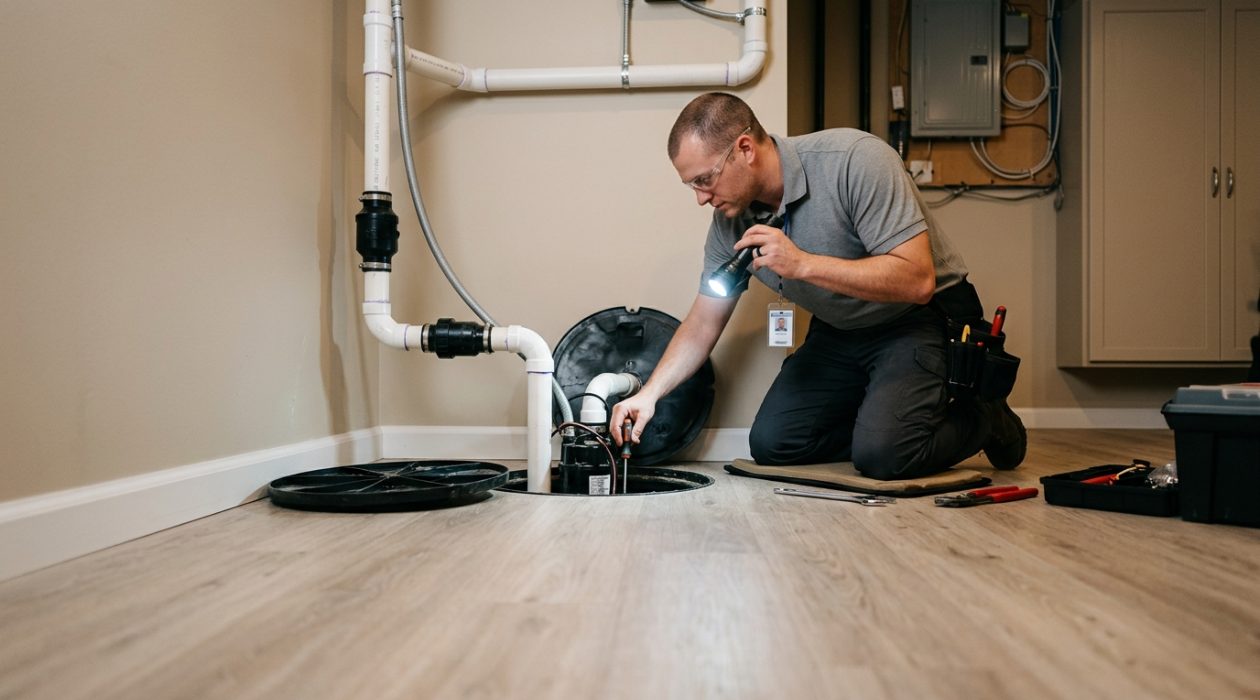
The pump in your basement pit gets asked to work about four weeks a year, and it always picks one of those weeks to fail. Repairs, replacements, battery backup and discharge lines that don’t freeze shut.
(970) 973-0235Almost every house in Greeley has a lower level, which means almost every house has a lowest point where water will collect if it gets the chance. Three local conditions conspire to give it that chance.
Snowmelt arrives all at once. A warm week in March can put weeks of accumulated snow into the ground over a couple of days, and if the ground is still frozen underneath, most of it moves laterally rather than down, straight along the path of least resistance toward your foundation.
The soil holds and moves. Expansive clay swells when it takes on water and shrinks as it dries. That seasonal movement is hard on foundations and on the drain tile around them, and it means the water that reaches a basement wall doesn’t drain away quickly on its own.
Storms and outages travel together. The heaviest inflow events on the plains come with wind and lightning, and the power tends to go with them. A pump with no backup is a pump that isn’t there on the night it matters most.
A dry-week service call costs a fraction of a wet-week emergency, and you get to choose the appointment.
 The failure modePump out, melt in, everything stored low is gone
Continuous or near-continuous cycling with no obvious inflow. Most often a check valve letting the discharge column fall back into the pit: the same water, over and over, until the motor gives up.
Motor energised, impeller jammed or seized, or the discharge blocked by ice or debris. Cut power at the breaker before touching anything in the pit.
On, off, on, off within seconds. A float set too tight, a pit too small for the inflow, or an oversized pump emptying faster than the pit refills. Switch wear follows quickly.
Grinding, rattling or a rising whine. Bearings, a chipped impeller, or gravel circulating in the volute. Noise is the cheapest warning you’ll get.
Failed float switch, tripped GFCI, failed capacitor, or a plug quietly knocked out of the outlet, which is more common than anyone likes to admit.
An inch of grit in the bottom of the pit shortens pump life dramatically and is the leading cause of jammed impellers. Pit cleaning is real maintenance, not an upsell.
The pit. It needs to be deep and wide enough for the inflow, connected properly to the drain tile if there is any, and clean. A silted pit is a pump killer. It also needs a sealed lid, which keeps debris and small animals out, reduces evaporation and radon entry, and stops the pit becoming an open hole in a room children use.
The pump. Cast iron sheds heat better and lasts longer than plastic in heavy duty. Submersible units are quieter and standard in finished basements; pedestal pumps are still around in older installations and are easier to service. Sizing is about inflow rate and vertical lift, not horsepower bragging rights.
The switch. The most common single point of failure in the whole system. Tethered floats, vertical floats and electronic sensors all have their trade-offs, and all of them fail eventually: usually by sticking rather than by going dead, which is why a pump can look fine and still not start.
The check valve. A small part with an outsized job: it stops the water in the vertical discharge from falling back into the pit each time the pump stops. When it fails, the pump short-cycles constantly. A quiet check valve also spares you the water-hammer thump that echoes through a finished basement at 3am.
The discharge line. Where most local trouble lives. It must pitch continuously downhill away from the house with no low spots, exit far enough out that the water doesn’t simply return through the foundation, stay above the frost line or drain fully, and, in this climate, have a freeze-relief provision so a plugged outlet doesn’t back the whole system up. Discharging to the sanitary sewer is prohibited in most jurisdictions for good reason.
A sump pump that works perfectly is useless if what it pumps has nowhere to go. This is the failure mode that surprises people, because the pump itself is fine.
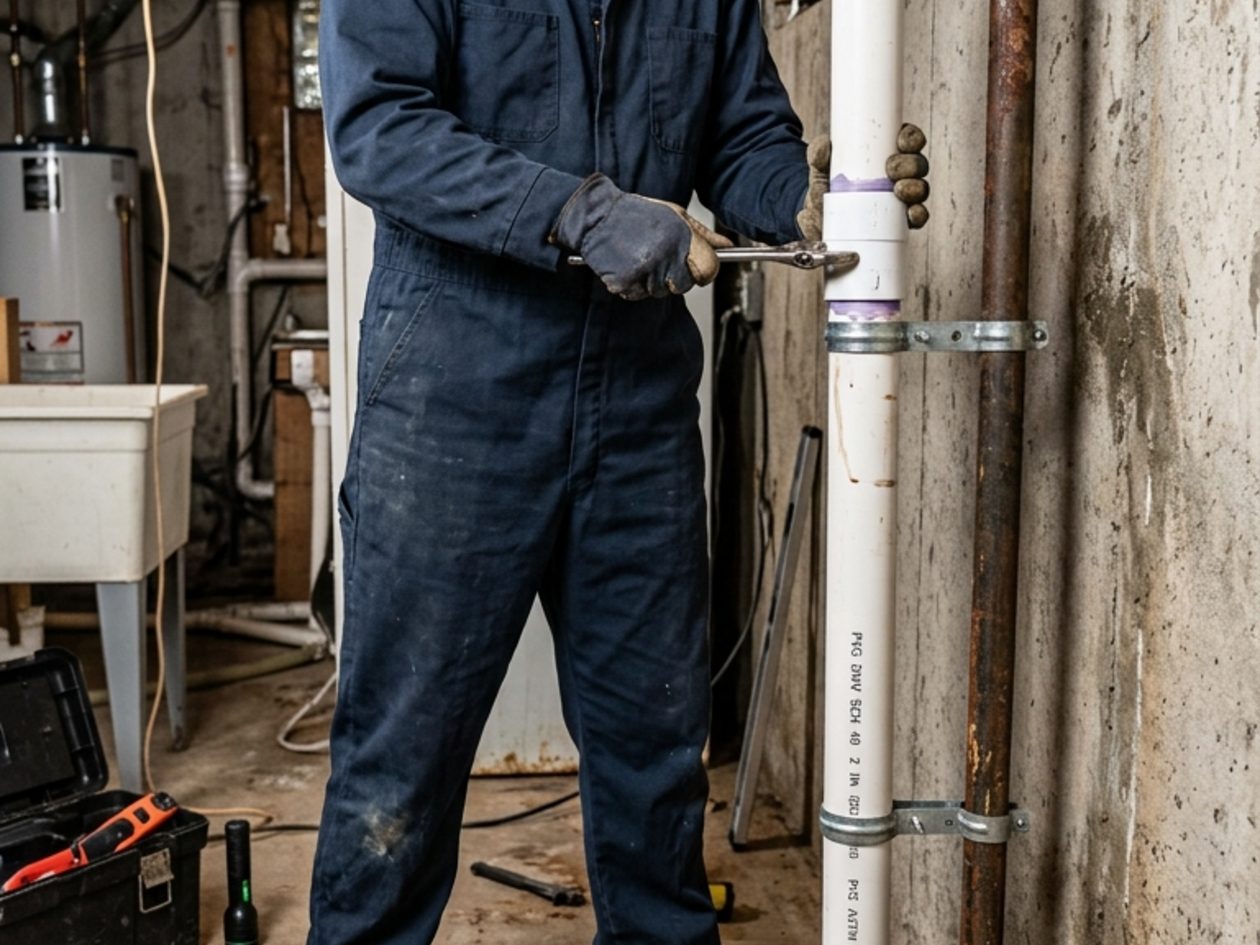
After every cycle, a small amount of water remains in the discharge line. Outdoors in a Greeley January that water freezes, and each subsequent cycle adds to the plug rather than clearing it. Eventually the pump is running against a solid obstruction: the motor works, the pit stays full, and the overflow finds your floor. Mid-winter thaws make it worse, because they generate inflow at precisely the time the outlet is most likely to be blocked, and a discharge buried in a snow drift or terminating in a frozen buried pipe can’t self-clear.
Ten minutes of testing in October is the difference between a working pump and a wet basement in March.
Water coming up the floor drain is a different problem with a similar puddle.
See details →Slow floor and laundry drains that can’t take the volume when it counts.
See details →Water arriving from a supply line rather than from outside the walls.
See details →Finding out whether the lateral is the reason the basement floods.
See details →Buried lines stressed by the same clay movement that cracks drain tile.
See details →Water on the floor right now, at any hour.
See details →High water table, pits that run most of the year rather than after storms.
Area details →Ground that stays saturated well into summer.
Area details →Flat ground and shallow basements, a combination that needs duty-rated pumps.
Area details →River-adjacent properties where a failed pump is a flooded basement.
Area details →Not on the list? We cover Greeley, Weld County and the northern Front Range, see every service area.
Pour water into the pit, five gallons is usually enough, and watch the whole cycle. The float should rise, the pump should start without hesitation, the water level should drop steadily, and the pump should shut off cleanly rather than short-cycling on and off. Then go outside and confirm water is actually leaving the discharge point, well away from the foundation. Lifting the float by hand proves the switch works but not that the impeller is moving water, which is why the bucket test is the real one. Do it twice a year: once in autumn, once before spring melt.
Either it’s genuinely dealing with a lot of water, or it isn’t clearing what it pumps. The second case is more common and more damaging: a stuck check valve lets the discharge column fall straight back into the pit, so the pump empties and refills the same water indefinitely. Other causes are a float tethered too tightly, a pit that’s too small for the inflow, a partially blocked discharge line, or an undersized pump. Continuous running burns motors out fast, so it’s worth diagnosing rather than tolerating.
Usually a jammed impeller: gravel, silt, a chunk of the pit lid, or the plastic remains of something that fell in. Sometimes a seized motor or a failed capacitor. Occasionally the discharge is frozen solid, which in a Greeley February is a real possibility, and the pump is simply pushing against a plug of ice. Cut power at the breaker before anyone reaches into the pit, and don’t keep cycling it, running a jammed pump repeatedly is how a repair becomes a replacement.
No, and plenty of houses here have never had one. What determines it is your lot, your soil, your drainage and your history: a home at the low point of a block, one with a high seasonal water table, one where the grading slopes back toward the foundation, or one that has ever had water on the floor during spring melt is a candidate. Homes with perimeter drain tile essentially require a pit and pump to give that system somewhere to discharge. If you’re unsure, the useful evidence is efflorescence on the walls, a stained line on the floor, or rust marks on anything stored low.
In this county, it’s the single best upgrade available. The problem is correlation: the storms that put the most water into the ground are the same events that knock the power out, so the pump is most needed exactly when it has no electricity. A battery backup system runs the pump for hours on its own, and better installations include an alarm so you know it’s working. Water-powered backups exist as an alternative on municipal supply. Either way, backup batteries have a service life, test annually and replace on schedule rather than discovering it flat in April.
Because it’s outdoors, it’s often the wrong slope, and a small residual column of water sits in it after every cycle. Once that freezes, the pump can’t clear the pit and the water goes across your floor instead. The fixes are all about drainage and geometry: continuous downhill pitch away from the house so the line self-drains, no low spots holding water, a large-diameter or freeze-relief discharge fitting that gives water an alternative exit if the outlet plugs, and the outlet kept clear of snow drifts. A line that discharges into a buried pipe needs particular attention, buried lines freeze quietly.
Roughly seven to ten years for a decent unit in average duty, considerably less for a bargain pump in a wet basement running weekly. Cast-iron bodied pumps with mechanical float switches generally outlast plastic units with vertical switches. Age alone isn’t the whole story, what matters is cycle count. A pump entering its second decade in a house that has needed it every spring is living on borrowed time, and replacing it during a dry week is dramatically cheaper than replacing it during a wet one.
Sizing comes from how much water arrives, how high it has to be lifted, and how far it has to travel, not from picking the biggest number available. An oversized pump short-cycles, which wears the switch and the motor. An undersized one runs continuously and loses the race during heavy melt. A plumber measures the pit, checks the inflow rate under load, works out the vertical lift and discharge run, and specifies from that. Where reliability really matters, two pumps in the same pit set at different levels is a better answer than one very large one.
Swapping a like-for-like pump into an existing pit is within reach of a confident homeowner. A new installation is a different proposition: cutting a pit through a concrete floor, connecting it to drain tile, getting the discharge routed and pitched properly, and doing the electrical work to code, sump circuits should be dedicated and GFCI-protected. Discharging into a sanitary sewer is prohibited in most jurisdictions and can cause backups elsewhere. It’s worth confirming local requirements before starting rather than after an inspection.
A faint earthy or damp smell is normal. A sewer or rotten smell is not, and it usually means one of three things: the pit is dry and a nearby floor drain trap has evaporated, the pit is collecting something it shouldn’t, laundry discharge or a cross-connection, or there’s organic sludge in the bottom of a pit that has never been cleaned. Cleaning the pit is legitimate maintenance and often solves it. If the smell is genuinely sewage, stop guessing and have it looked at, because a cross-connection between a sump and a sanitary line is a health issue rather than an inconvenience.
Not sure whether yours is working? Describe what it does when you pour water in.
Sump pump repair, replacement and battery backup across Greeley, Evans, Windsor and Weld County.
(970) 973-0235Answered 24 hours a day, seven days a week, every week of the year.