Burst Pipe Repair
If it has already let go: shut-off, containment, permanent repair.
See details →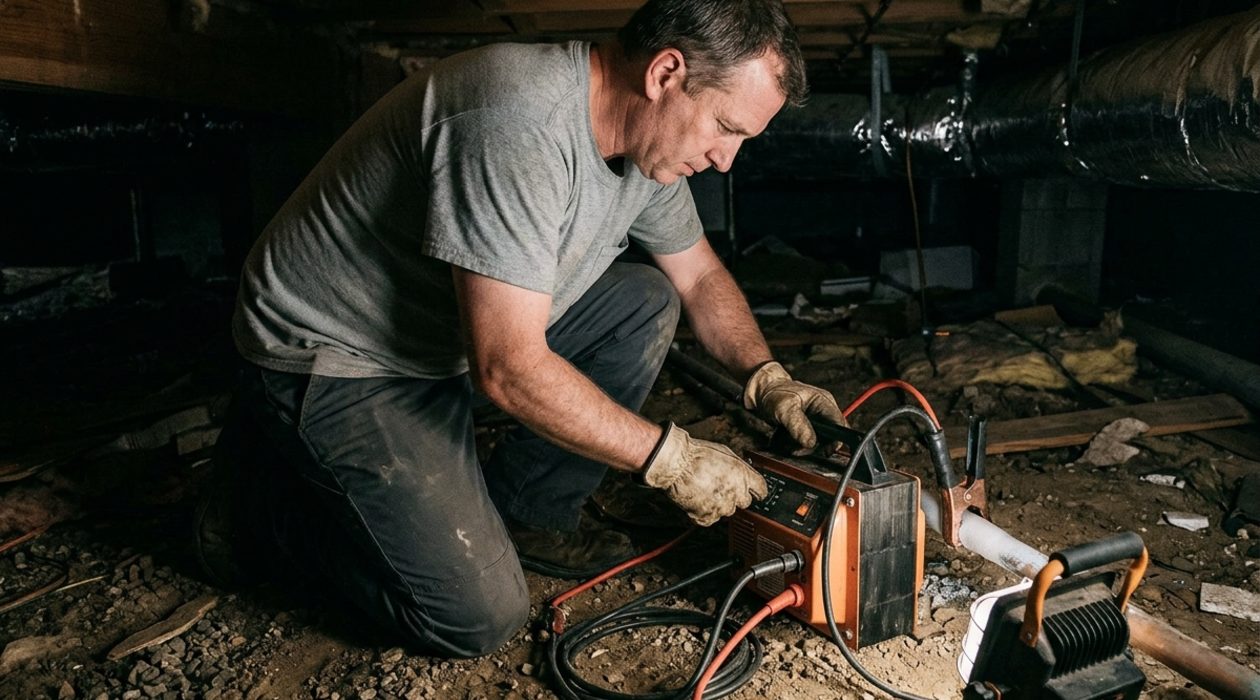
No flow at one fixture on a cold morning is the early warning, and the cheapest moment to act. We route thawing and repair calls to plumbing pros who work Front Range crawlspaces and rim joists all winter.
(970) 973-0235Almost nobody calls saying “my pipe is frozen.” They call saying the shower ran fine yesterday and today it does nothing, or that the kitchen tap works but the laundry sink doesn’t. The pattern is more useful than any single symptom.
The window between “frozen” and “burst” is where this stays inexpensive.
 Where it happensCrawlspaces, garages, rim joists, exterior walls
Understanding this changes what you do in the first ten minutes, so it’s worth two paragraphs.
Water expands roughly nine per cent as it freezes, but the pipe rarely fails at the ice. What kills pipes is hydraulic pressure. The plug forms, water behind it has nowhere to go, and every demand on that line: a running tap, a filling toilet, the water heater pulling in cold, raises pressure in the trapped section. Copper can hold a great deal, so the failure appears at the weakest link: a solder joint, a threaded fitting, a compression connection, sometimes several feet away from the frozen spot and in a completely different room.
That has two practical consequences. First, opening a faucet on the affected line is genuinely useful, it gives the pressure somewhere to go and gives melt water an exit. Second, the thaw is the dangerous part, not the freeze. A plug that releases while nobody is home turns a stressed joint into an open pipe running at full mains pressure, which is why so many burst calls arrive late morning on the day after the cold, and why finding your main shutoff before winter matters more than any gadget you can buy.
Locate before heating. Guessing wastes hours. A plumber narrows it down by which fixtures are dead, then confirms with an infrared thermometer or thermal camera along the suspected run, the frozen section reads dramatically colder than the pipe either side of it. In finished space, that’s also how you avoid opening the wrong wall.
Thaw with controlled heat, from the right direction. Heat is applied starting nearest the open fixture and worked back toward the plug, so melt water always has an escape route. Steam or electric thawing equipment on accessible pipe, warm-air methods in enclosed cavities, and patience where the pipe is buried in a wall assembly. The faucet stays open the whole time.
Inspect under pressure. Once flow returns, the section is watched at full pressure. Bulged copper, weeping joints, distorted fittings and split plastic all show up now rather than next week. Anything suspect is cut out and replaced rather than left to be someone’s problem in February.
Fix the reason. This is the part that decides whether you call again next month. Insulation added or corrected. An open crawlspace vent blocked. Rim-joist air sealing. Self-regulating heat cable on a run that will always be marginal. Occasionally rerouting a line out of an exterior wall entirely, which is more work now and the end of the problem permanently.
Tell you what to expect. If a line froze because of how the house was built, and in a lot of Greeley additions and finished basements, it was; you should hear that plainly, along with what it would take to solve properly versus manage seasonally.
That’s a burst, and the clock matters. Close the main, open a low faucet to drain the system, keep away from anything electrical near the water, and call.
Prevention, honestly. Every frozen-pipe call we route in January traces back to something that cost very little in October: a hose left on a bib, a vent nobody closed, insulation that stopped two feet short. A winterization visit is cheap by comparison with the drywall.
A pipe that froze and thawed without splitting has still been stressed, and the damage often shows up somewhere other than the frozen section. Work through the house in this order over the following week.
Every fixture the frozen line feeds, run for a full minute each. You are looking for reduced flow compared with before, which suggests debris shifted loose inside the pipe, and for discolored water, which suggests the interior surface was disturbed.
The ceiling below the frozen run, checked twice: once immediately, once after two or three days. A pinhole split leaks slowly and the stain arrives late. Feel the plasterboard rather than only looking at it, damp reads before it discolors.
Shutoff valves on the affected branch. Valve packings are a common casualty; a valve that was dry before and weeps at the stem now has been damaged. Better to find it in February than the next time you need to isolate that line in a hurry.
The water meter, with everything off. If the dial is turning, something on the system is losing water. That is the single most reliable check available to a homeowner, and it takes a minute.
If it has already let go: shut-off, containment, permanent repair.
See details →Irrigation and backflow drained before the first hard freeze.
See details →Split bibs, frost-free replacements, and the wall leaks they cause.
See details →Buried service lines that freeze at shallow or disturbed depth.
See details →24/7 dispatch when it can’t wait until morning.
See details →Old galvanized runs in places nobody would put pipe today.
See details →Crawlspace runs under uninsulated floors on the coldest nights of January.
Area details →Additions and enclosed porches carrying supply through unheated space.
Area details →Wind exposure, which freezes a pipe faster than still air at the same temperature.
Area details →Long service lines and outbuildings that lose heat before the house does.
Area details →Not on the list? We cover Greeley, Weld County and the northern Front Range, see every service area.
The tell is temperature and pattern. A frozen line gives you no flow or a trickle at one or two fixtures, it happens after a cold night rather than gradually, and the affected fixtures are usually on the same branch, often the coldest wall in the house. Frost or beads of condensation on exposed pipe, a bulge in copper, or an unusually cold cabinet under a sink all point the same way. A blockage, by contrast, affects drainage rather than supply and doesn’t care what the weather is doing.
On an accessible run: exposed copper or PEX in a basement, a pipe under a sink you can reach: a hair dryer, a heat lamp at a safe distance, or towels soaked in hot water applied from the fixture end back toward the frozen section is a reasonable thing to try, with the faucet left open so melt water can escape. Never use a torch, a propane heater or any open flame: thawing pipes with flame is a documented cause of house fires, and on older solder joints it will melt the joint outright. Anything inside a wall, under a floor, in a crawlspace, or that you can’t see and reach is a job for someone with the right equipment.
Not because ice splits the pipe from inside. Ice forms a plug, and then continued demand: a running faucet, a filling toilet, the heater drawing water, pressurizes the trapped water between the plug and the closed fixture. Pressure climbs until the weakest point in that section gives way, and that’s usually a fitting, a solder joint or a threaded connection several feet from the ice itself. It also explains the cruel timing: many bursts announce themselves during the thaw, hours after the cold snap has passed and the plug finally releases.
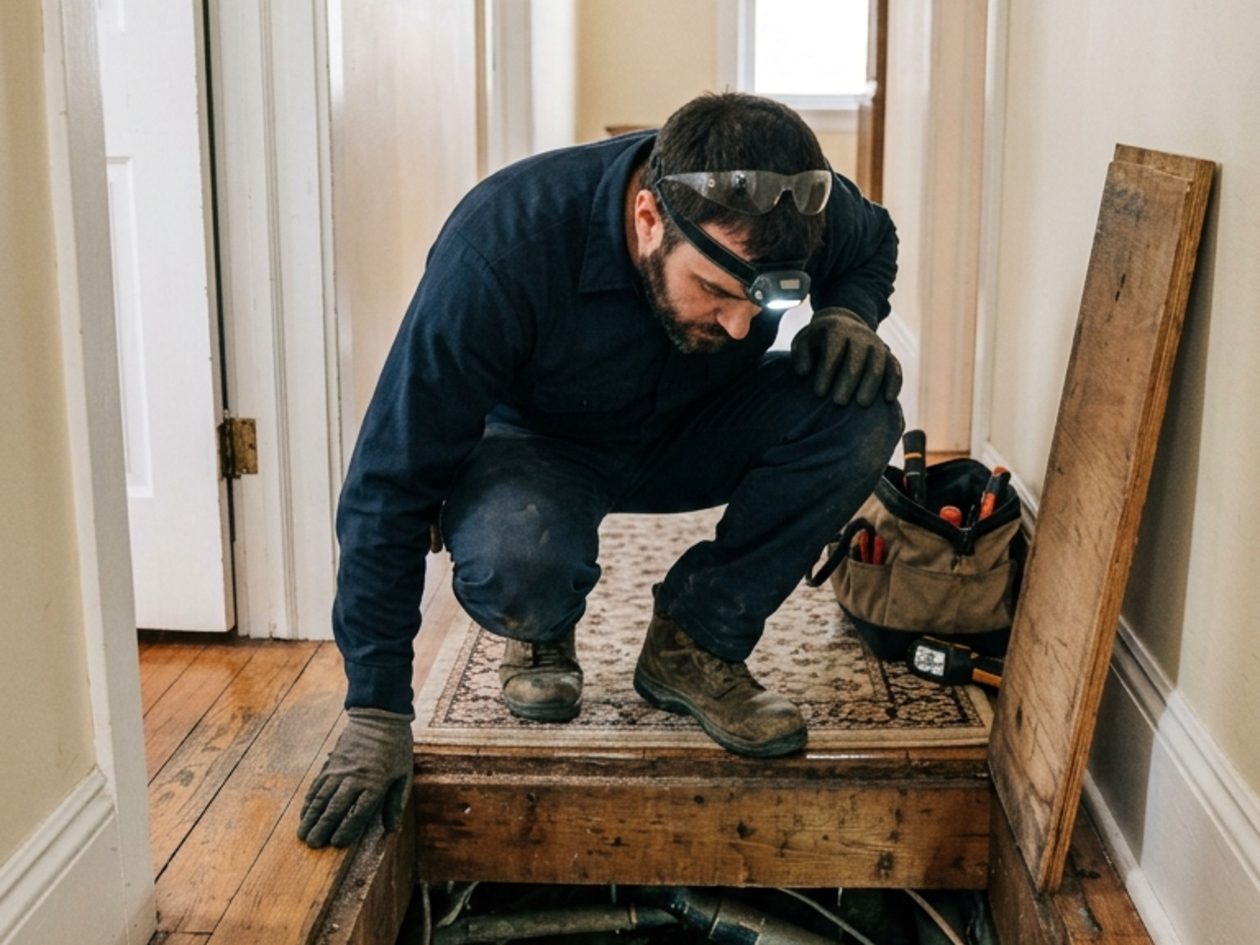
Crawlspaces with open foundation vents. Unheated attached garages, especially where the laundry or a utility sink sits on an outside wall. Basement rim joists where cold air tracks in above the foundation. Supply lines run through exterior walls in additions and finished basements, which frequently have less insulation than the original house. Hose bibs left with a hose attached. And in the older housing off Lincoln Park and through Sunrise, galvanized lines in places nobody would run pipe today, the result of a century of remodels.
Calling is the cheap version of this problem. A pipe that froze once has been stressed, and copper that has bulged or a solder joint that has been strained can fail weeks later under normal pressure. A plumber thaws it under control, then pressure-checks the section and looks at the whole run for the reason it froze: a missing insulation section, an open vent, a pipe on the wrong side of the insulation. Fixing that is what stops it happening again on the next cold night, which is the part homeowners usually skip.
An accessible section with good heat access is often twenty minutes to an hour. A line inside a wall or under a slab floor can take several hours, because heat has to travel through the building before it reaches the ice. Steam and specialized thawing equipment speed this up considerably and are safer than improvised heat. If the freeze is in a buried service line, which happens here in shallow or disturbed runs, it becomes a different and much larger job.
Yes, for the pipes you know are vulnerable, and it’s cheap insurance during an extreme cold snap. A slow trickle on the fixture furthest along a cold run keeps water moving and relieves pressure if a plug does start to form. Open the cabinet doors under sinks on exterior walls so room heat reaches the pipes, and don’t set the thermostat back at night during a hard freeze, the saving is a few dollars and the risk is a repair plus drywall.
Generally yes in winter, and it’s one of the most effective things you can do on a Front Range house with a vented crawlspace. Open vents in January pour freezing air directly onto supply lines. Foam blocks or rigid covers are the usual approach, remembering that combustion appliances need their own combustion air and shouldn’t be starved. If your crawlspace has a persistent problem, insulating the pipes themselves and adding heat tape on known runs is the more durable answer.
Properly specified and correctly installed, yes: self-regulating heat cable on a known problem run, covered with insulation, is standard practice for crawlspaces and rim joists. The failure modes are all installation-related: cable wrapped over itself, cheap constant-wattage cable left on all summer, no GFCI protection, or tape installed and then forgotten for fifteen years until the jacket has degraded. Have it looked at as part of a winterization visit rather than trusting it indefinitely.
Two workable approaches. Keep the house heated to at least 55°F with someone checking it during cold snaps, heat only helps if the furnace is actually running and the power hasn’t gone out. Or have the system properly winterized: water off at the main, lines drained from the lowest point, traps and toilets protected with antifreeze rated for plumbing, and the water heater drained and shut down. Half measures are what cause the worst cases we see: an empty house, a failed furnace, and nobody walking in for six weeks.
Not sure if it’s frozen? Describe which fixtures work and which don’t, that usually settles it.
Thawing, repair and the fix that stops it recurring: across Greeley, Evans, Windsor and Weld County.
(970) 973-0235Answered 24 hours a day, seven days a week, every week of the year.