Meter and isolation
Establish that water is genuinely being lost, then close sections in turn to determine where: house, irrigation, or buried service line, before any equipment comes out.
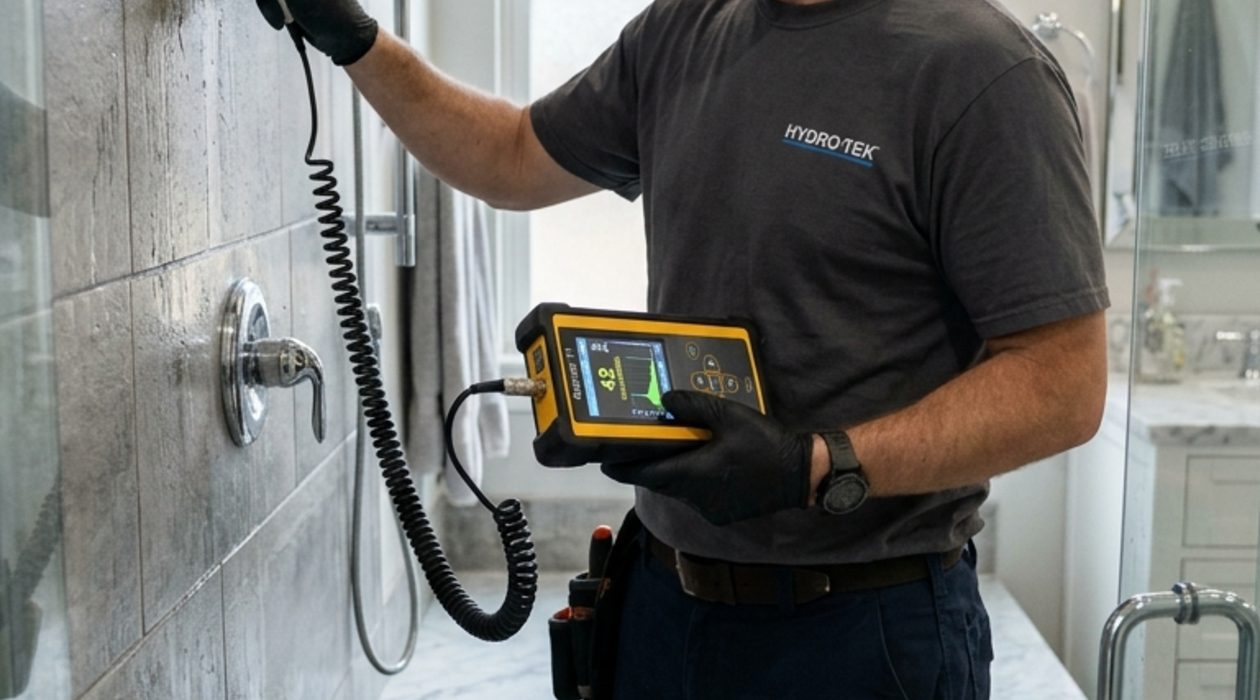
A meter that keeps creeping with everything shut off. A stain that grows. A musty smell that arrived last month. We locate it acoustically and thermally first, so the repair is one access point rather than four holes.
(970) 973-0235Turn off every tap, appliance, ice maker and the irrigation system. Read the meter. Wait an hour without using water. Read it again. If it moved, water is leaving your system, and you’ve just done the most valuable ten minutes of the whole diagnosis.
Check the sprinklers first. Underground irrigation leaks are one of the most common causes of a moving meter, and they’re a far smaller repair than anything inside the house. Close the irrigation isolation valve and repeat the test.
Inside a wall. A stain that grows week by week, paint bubbling or blistering, drywall that feels cool and slightly soft, or a faint hiss audible only when the house is quiet at night. On a two-story house the water frequently travels along a joist before it appears, so the visible mark can be a considerable distance from the actual failure.
Under a floor or in a crawlspace. A musty smell that wasn’t there before. Flooring that has started to cup, lift or feel spongy. A warm patch underfoot on a hot-water line. Running water audible with every fixture closed. Crawlspace leaks are the ones that run longest undetected, and standing water under a house is a structural moisture problem as much as a plumbing one.
Under a slab. Supply piping in or beneath concrete. A warm area on the floor, an unexplained running sound, cracking or lifting at flooring joints, and a meter that moves. Because access means cutting concrete, precision matters more here than anywhere else on this page.
At an appliance or fixture connection. Behind the washing machine, under the dishwasher, at the fridge ice-maker line, at a toilet supply riser or an angle stop. Small parts, large volumes, and the most preventable category on the list.
Outside, in the buried service line. Pressure fading at every fixture, a green or soft patch in an otherwise dry lawn, water surfacing near the curb, or in winter a bare thawed stripe in the snow along the pipe route.
Describe what you see, hear and smell, and where. That shapes which equipment comes out of the van.
Evidence before demolition Thermal and acoustic first, drywall saw last
Establish that water is genuinely being lost, then close sections in turn to determine where: house, irrigation, or buried service line, before any equipment comes out.
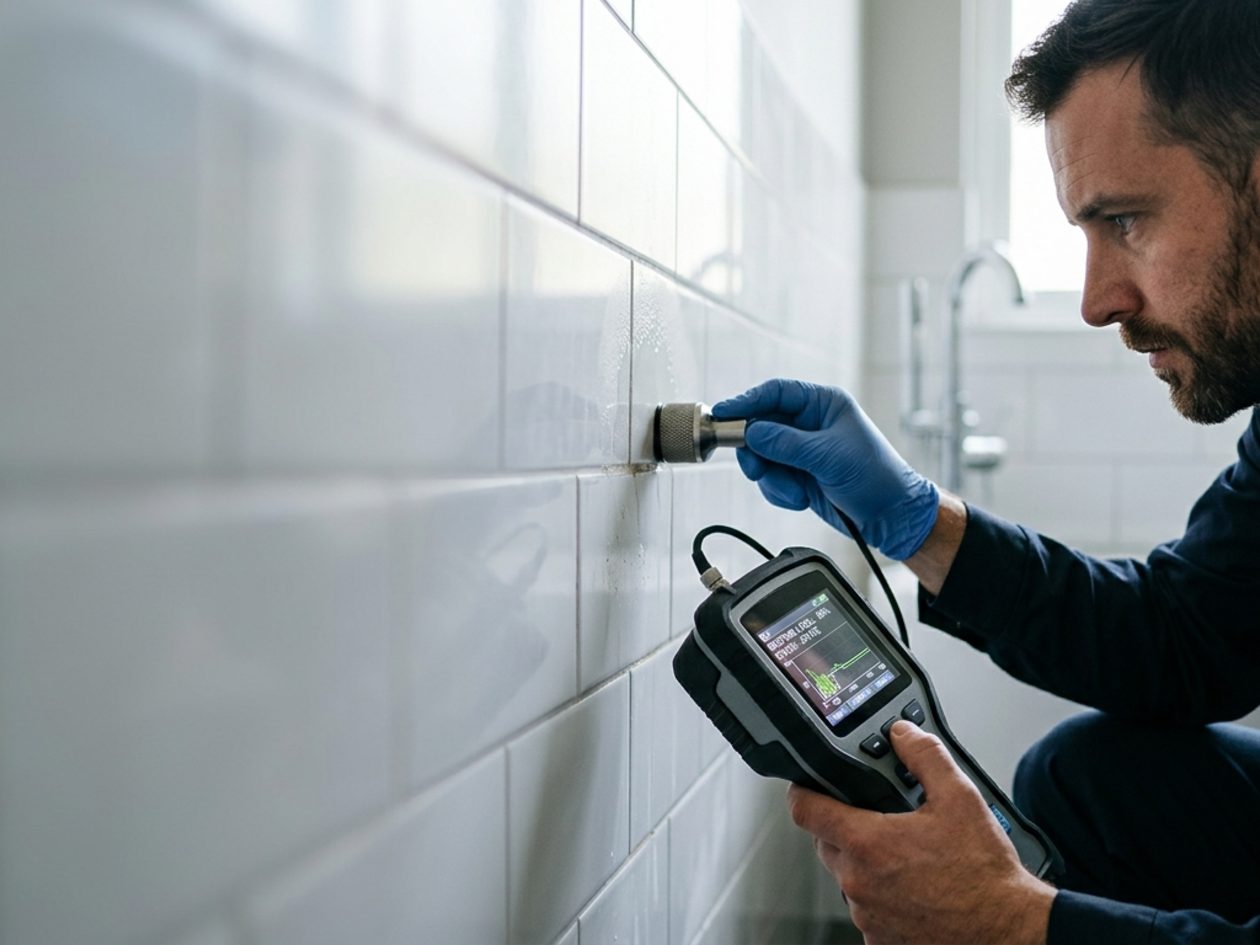
A pressurized leak makes noise. Ground microphones and contact probes amplify it through soil, slab and framing, and an experienced ear narrows position surprisingly tightly.
Water changes surface temperature. Thermal cameras reveal the shape and extent of wet areas behind finishes without touching them, which also shows how far the water has already traveled.
Meters quantify what’s wet and, importantly, where wet stops. That boundary is what tells you how much material is affected and whether remediation is needed.
An inert gas introduced into the line and detected where it surfaces. Useful where sound doesn’t travel well: low pressure, plastic pipe, or deeply buried runs.
Establishing where pipes actually run and how deep. Frequently the surprise of the visit, because pipe routes and assumptions diverge more often than not.
What you should expect from a detection visit: a specific location, an explanation of the evidence behind it, and the smallest sensible access point to confirm and repair. What you should not accept is a sequence of exploratory holes. If someone is cutting a third opening on a hunch, it’s fair to ask what evidence supports the fourth, and to note that plumbers repair pipe while drywall and paint are usually a separate trade and a separate bill.
If the meter is moving, waiting only adds drywall and flooring to the bill.
People delay leak detection because the symptom is mild. A slightly high bill, a faint musty note in one room, a patch of drywall that looks marginally off. Nothing is dripping visibly, so nothing feels urgent. The problem is that the cost of a concealed leak does not rise gradually with the volume of water: it steps up sharply as the water reaches new materials.
For the first stretch, you are paying for water. That is the cheap phase, and it is the only phase where the bill is the whole story.
Then the water saturates something absorbent, and the arithmetic changes. Drywall wicks moisture upward well beyond the actual leak. Insulation holds water against framing and stops drying. Subfloor and engineered flooring swell and delaminate, and delamination is not reversible: that material is replaced, not dried. At this point you have moved from a plumbing repair to a plumbing repair plus a restoration job, and the restoration is usually the larger number.
The next step is biological. Given moisture, darkness and a cellulose surface, mold growth begins in a matter of days rather than months. Once it is established inside a wall cavity, remediation means containment, controlled removal and disposal of affected material: a different trade at a different price, and one that cares about air quality rather than pipes.
The final step is structural and electrical. Persistent moisture against framing invites rot; water tracking along a joist bay finds junction boxes and outlets. This is where a leak stops being a repair bill and becomes a safety issue.
There is an insurance dimension too, and it is the part most homeowners find out about too late. Policies broadly cover sudden, accidental water damage. Damage from a leak that can be characterised as long-term, gradual, or something a reasonable owner should have noticed and addressed is frequently excluded. In practice that means the longer you leave a leak you knew about, the more likely you are carrying the full cost yourself. Documenting when you first noticed something and when you acted on it is genuinely worth doing.
None of which is an argument for panic. It is an argument that the cheapest day to locate a leak is always the first day you suspect one.
Note the date you first noticed it. Acting promptly matters for the repair and for any claim.
When the loss is in the buried service line.
See details →When a slow leak becomes a sudden one.
See details →The pressure that caused the failure in the first place.
See details →Repeated pinholes in pipe at end of life.
See details →Water actively spreading, at any hour.
See details →Leaks at stops, traps and supply connections.
See details →Hillside pressure variation that finds the weakest fitting in the house.
Area details →Large footprints where a slab leak can run for months unnoticed.
Area details →Crimp fittings inside walls, which leak slowly and stain a ceiling first.
Area details →Newer homes where the bill moved but nothing is visibly wet.
Area details →Not on the list? We cover Greeley, Weld County and the northern Front Range, see every service area.
The meter test. Shut off every tap, appliance, ice maker and the irrigation system, then read the meter and note the leak indicator dial. Wait an hour, touching nothing, and read again. Movement means water is leaving the system. That single hour tells a plumber more than any description, because it separates “something is leaking” from “something used more water than usual.” From there, isolating sections narrows down where.
A meter that advances with everything off. An unexplained rise in the bill. The sound of running water when the house is quiet. A musty smell that arrived recently. Warm or cold patches on a floor. Paint bubbling, drywall that feels soft or cool, or a stain that grows. Rust marks at a nail head in a ceiling. Flooring that has started to cup or lift. Outside: a green patch in a dry lawn, or a bare spot in snow along a pipe route.
Several methods, usually in combination. Acoustic listening amplifies the sound a pressurized leak makes through pipe and building materials. Thermal imaging shows temperature differences where water has spread behind a surface. Moisture meters quantify what’s wet and map the boundary. Pressure isolation determines which section of the system is losing water. Tracer gas can be introduced and detected where sound won’t travel. The goal is a small, defensible access point rather than exploratory demolition.
A leak in supply piping run within or beneath a concrete floor slab. They’re miserable because the water often travels along the slab before appearing, so the visible symptom can be a long way from the failure. Signs include a warm patch on the floor if it’s a hot line, an unexplained running sound, cracking or lifting flooring, and a meter that moves with the house off. Location has to be precise, because access means cutting concrete, which is exactly why acoustic and thermal work matter before anyone starts.
Very often, and it’s the first thing worth eliminating because it’s a much smaller repair. Underground sprinkler leaks are a common cause of an advancing meter, and they hide well, the water goes exactly where water is supposed to go. Check that the irrigation controller is genuinely off and the system’s isolation valve is closed, then repeat the meter test. If the meter stops moving, you’ve found your answer and saved yourself an investigation of the house.
More than the size suggests, because it never stops. A drip that seems trivial runs twenty-four hours a day, every day, and a pinhole under pressure in a wall cavity or under a slab can waste a substantial volume monthly while remaining entirely invisible. The bigger cost is usually not the water. It’s what continuous moisture does to framing, insulation, subfloor and drywall over weeks, and the remediation that follows.
That’s between you and your carrier, and the distinction they typically draw is between sudden accidental discharge and long-term seepage. A pipe that fails abruptly is treated differently from one that has been weeping for months, and the cost of finding and repairing the pipe is often handled differently from the resulting damage. Photograph everything, keep the written diagnosis and the detection report, and contact your carrier early rather than after repairs are done.
Yes: detection is the diagnostic step, and the repair follows once the location and cause are established. What plumbers generally don’t do is the building restoration: drywall, paint, flooring and drying out the structure are separate trades. A good local pro will tell you honestly whether you need water-damage remediation, which mostly depends on how long the water ran and how much porous material it soaked.
Not with a supply leak. The failure mode is one-directional: pipes and fittings don’t heal, pressure keeps working on the weak point, and the damage compounds while materials stay wet. Waiting turns a located repair into a located repair plus insulation, drywall, flooring and possibly mold remediation. If the meter is moving with everything off, the useful question isn’t whether to act, it’s how precisely the leak can be located before anything is opened.
Detection is priced as a diagnostic visit rather than by the leak, and it is a small fraction of what the repair and any restoration will run. What moves the price is how much equipment the job needs: a leak that isolation and a meter reading narrow down quickly is at the low end, while one requiring thermal imaging, acoustic listening and tracer gas across a slab takes longer.
Ask two things when booking: whether the detection fee is credited against the repair if you go ahead with the same company, and whether you get a written location and depth rather than a verbal indication. Both are common and both are worth having, because a precise location is what keeps the repair to one opened wall instead of three exploratory ones.
Run the meter test first, an hour with everything off is the best evidence there is.
Acoustic and thermal leak detection across Greeley, Evans, Windsor, Eaton and Weld County.
(970) 973-0235Answered 24 hours a day, seven days a week, every week of the year.