Drip from the spout
Worn cartridge, ball seats or compression washer. The seal that stops flow when the handle is closed has given up. Cheapest and most common repair we do.
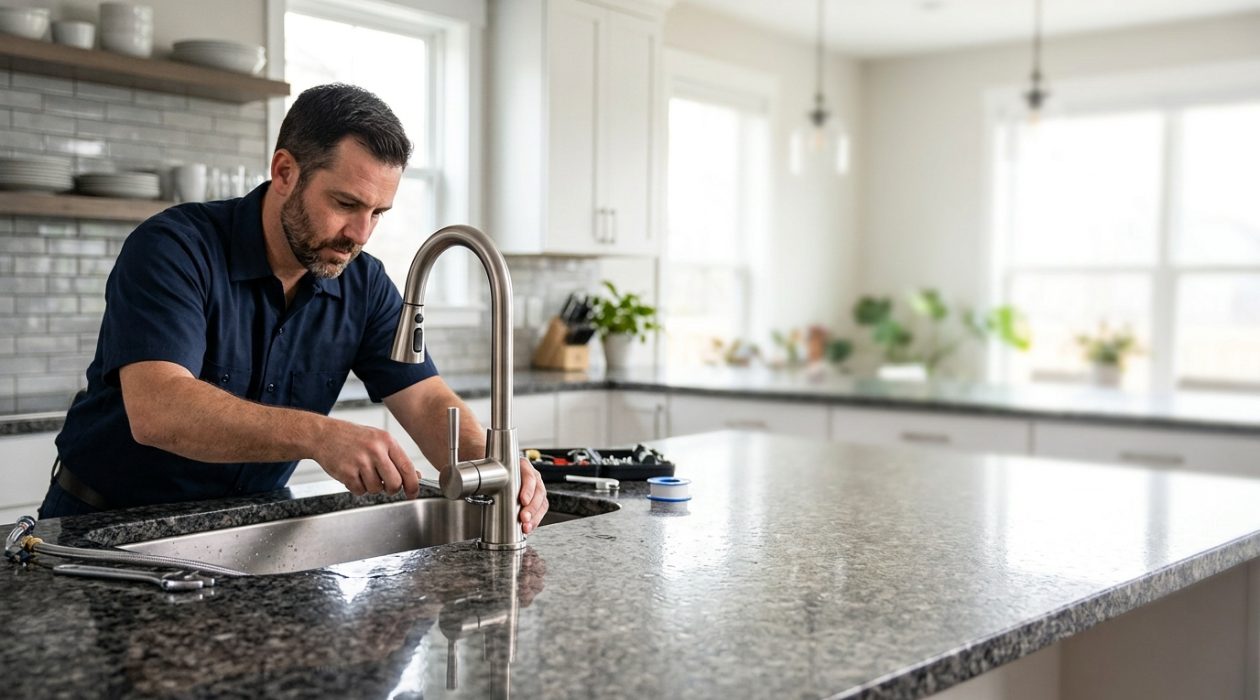
A dripping faucet is rarely the whole story. Hard water, worn cartridges and thirty-year-old angle stops all show up in the same visit, and we deal with them while the water is already off.
(970) 973-0235A faucet dripping once per second wastes roughly three thousand gallons a year. On a Greeley water bill that is real money but not catastrophic money, which is exactly why drips get ignored for months. The reason to fix one quickly has less to do with the meter and more to do with what the drip is doing to everything around it.
Constant moisture at a spout base rots the particle board under a sink deck. Water tracking down a supply riser corrodes the angle stop until it seizes, which means the day you actually need to shut that fixture off, you cannot, and a five-minute cartridge swap becomes a shutoff-the-house repair. Mineral-laden water dripping on a stainless sink leaves etching that never comes out. And a hot-side drip is heated water leaving the building continuously, which quietly adds to the gas bill too.
The fix is almost always small. Faucets are simple machines: a valve, a seal, a handle. Ninety per cent of the drips we repair come down to a worn cartridge, a hardened o-ring, or a seat that our water has scaled over. What makes the visit worthwhile is doing the surrounding parts: the stops, the risers, the aerator, while the access is already open.
Most repairs done in a single visit, common cartridges on the van.
A cartridge faucet: the most common modern design, single or double handle, controls flow with a replaceable plastic or brass cartridge. When it drips, the cartridge is worn and you replace it. Brand and model matter enormously here: Moen, Delta, Kohler and Price Pfister cartridges are not interchangeable, and there are dozens of variants within each brand.
A ball faucet is the classic single-lever kitchen faucet with a rounded body. Inside is a slotted metal ball riding on spring-loaded rubber seats. Drips come from the seats and springs, which are cheap and sold as a kit, though the ball itself can score with age.
A compression faucet is the old two-handle design where the handle screws down against a rubber washer. Still all over Greeley’s older housing stock. The washer wears, or the brass seat it presses into gets pitted, and replacing the washer without dressing or replacing the seat means you are back in six months.
A ceramic disc faucet uses two polished ceramic plates. These last a very long time and rarely drip, but our hard water can leave deposits on the discs that hold them a fraction of a millimetre apart. Cleaning sometimes works; a new disc cylinder is the reliable fix.
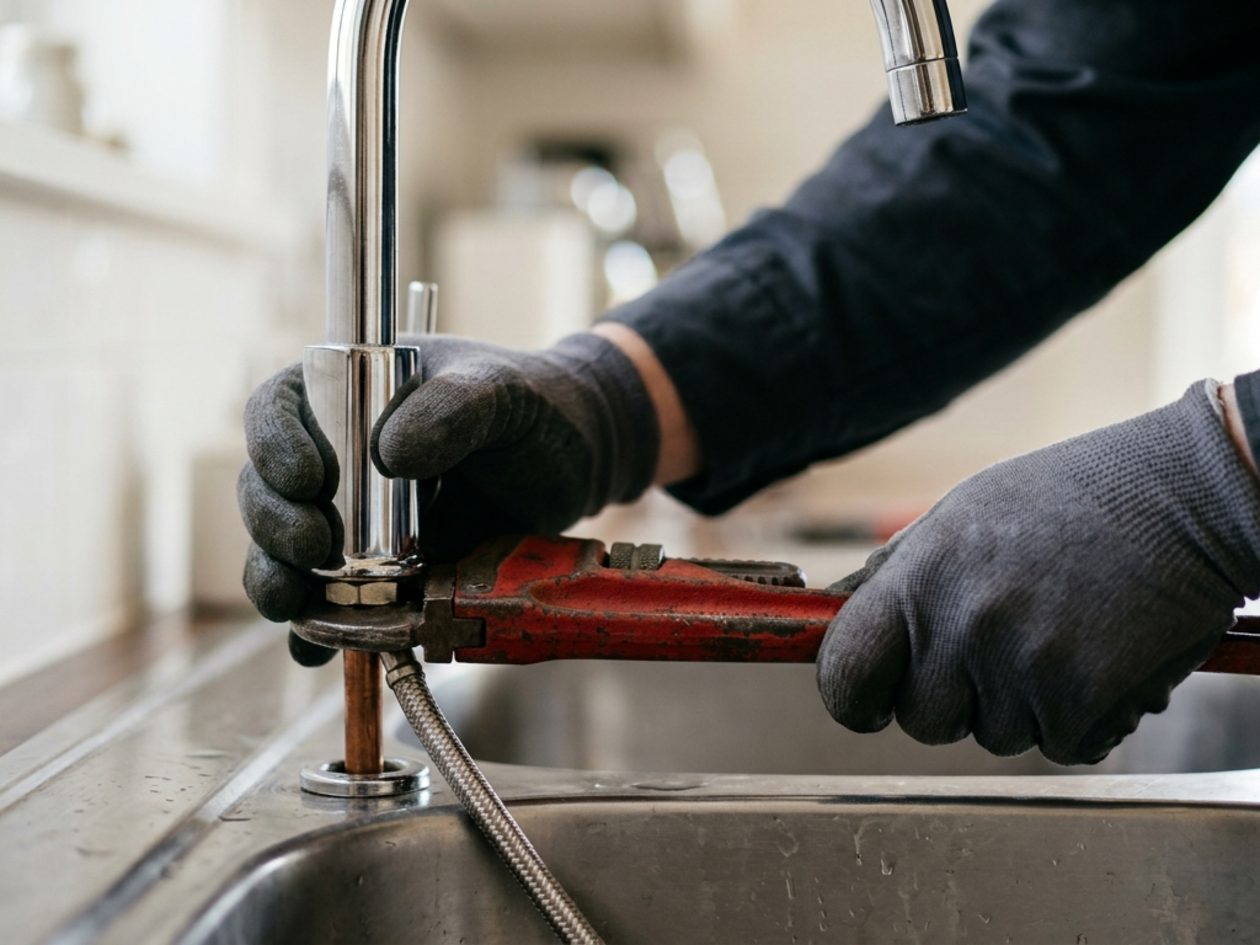 Brand-specific partsThere is no universal cartridge. Identifying the exact model is half the repair on any faucet older than a decade.
Every fixture in your house is supposed to have its own shutoff so a repair does not require killing water to the whole building. In practice, in homes older than about twenty-five years, a meaningful share of those angle stops no longer turn. Multi-turn stops with a rubber washer inside seize when they sit untouched for decades, and the handle either refuses to move or snaps off in your hand.
We replace failing multi-turn stops with quarter-turn ball stops as a matter of course during faucet work. A quarter-turn stop has no compressible washer to harden and no packing nut to weep, and it goes from open to closed in ninety degrees. It costs very little on top of a repair you are already paying for, and it is the difference between a calm fifteen minutes and a flooded cabinet the next time something fails at two in the morning.
The braided supply risers get the same treatment. The stainless braid hides a rubber tube, and that tube has a service life: the failure mode is a full-bore burst, not a drip, which is why a fifteen-year-old riser under a vanity is worth four dollars and five minutes to change.
If your shutoffs already do not work, tell us when you call. It changes how we stage the visit and whether we need to isolate at the main.
Done during any faucet or sink visit while the water is already off.
Quarter-turn, every time We swap seized multi-turn stops for ball stops during fixture work. It is the cheapest insurance in the house.
Worn cartridge, ball seats or compression washer. The seal that stops flow when the handle is closed has given up. Cheapest and most common repair we do.
O-rings around the valve body, hardened by heat and mineral content. Water appears on the deck when the handle is turned, then stops when it is off.
Almost always a clogged aerator packed with scale and grit, especially after main work. Occasionally a partially closed stop or a cartridge screen.
Could be the drain tailpiece, the P-trap slip joints, the supply connections or the sink rim seal. All four look identical from the floor; we dry it and pressure-test to isolate.
Diverter valve in the faucet body stuck, or a failed sprayer head. Common on older pull-out kitchen faucets where the hose has kinked.
The mounting nut under the deck has loosened. Left alone it flexes the supply connections until one of them leaks, a two-minute fix that prevents a real one.
We repair by default. A cartridge is a fraction of the cost of a fixture, the repair takes under an hour, and a decent faucet has plenty of life left in it after a rebuild. But there are four situations where replacing wins on cost, not just on looks.
The first is parts availability. Discontinued faucets from small importers often have no cartridge available at any price. We can sometimes match a generic, but sometimes we cannot, and hunting is not free.
The second is a corroded body. When mineral deposits have eaten into the valve seat inside the faucet casting, new seals will not seal against a pitted surface. You get a few good months and the drip comes back.
The third is repeat failure. A faucet on its third cartridge in five years is either a bad design or fed by water pressure high enough to be chewing through seals, and if it is the latter, the answer is a pressure regulator, not another cartridge.
The fourth is simply value. On an inexpensive builder-grade faucet, the parts and labor for a full rebuild can approach the price of a solid mid-range replacement with a lifetime cartridge warranty. We will say so when that is the case rather than quietly billing the rebuild.
We quote both options before touching anything.
Water here carries a substantial mineral load, and every faucet in the county is being slowly sandblasted from the inside by dissolved calcium and magnesium. You see it first at the aerator, where the screen packs with white grit within a year or two. You see it next in the cartridge, where scale builds on the sealing surfaces and stops them mating cleanly. You see it last in the valve seat, where deposits form, break away, and take a little brass with them each time.
This is why the manufacturer’s optimistic service life does not apply here. A cartridge rated for a decade of typical use might give you five or six years on untreated Greeley water. It is not a defect and it is not bad installation; it is chemistry.
Two things genuinely slow it down. Cleaning aerators once or twice a year takes five minutes with white vinegar and keeps grit out of the valve. And whole-home softening removes the hardness before it reaches any fixture, which extends the life of faucets, valves, the water heater and the dishwasher at the same time. We are not going to pretend a softener pays for itself on faucet cartridges alone, but if you are already replacing cartridges every few years and descaling the heater, it changes the arithmetic.
If you want to know what you are actually dealing with, we can test hardness during any visit and tell you where your house sits.
Sink work covers more than the tap. A cracked porcelain basin, a failed rim seal letting water under a drop-in sink, a sagging undermount that has broken its adhesive bond, a garbage disposal flange weeping into the cabinet: all of it is sink repair, and all of it presents as a mystery puddle.
The drain assembly is its own small system: strainer basket, tailpiece, P-trap, and the arm running to the wall. Slip joints there rely on plastic washers seated square. Anyone who has tightened one crooked has learned that a hand-tight joint done right beats a wrench-tight joint done wrong. Plastic traps crack when overtightened; chrome traps corrode from the inside and pinhole at the bend.
The pop-up assembly in a bathroom sink deserves specific mention because it is the most common source of a slow bathroom drain. Hair and soap wrap around the pivot rod behind the stopper and build into a plug that no plunger will move. Pulling the pivot nut, removing the stopper and cleaning the assembly takes minutes and solves what looks like a serious blockage.
If the slowness is in the wall rather than the fixture, that is a different job, and we would rather find that out with a proper look than by selling you a drain cleaning you did not need.
Hand-tight, seated square Most slip-joint leaks are a crooked washer, not a loose nut. Overtightening cracks the plastic and makes it worse.
The travel and setup is the fixed cost of any plumbing visit. If the kitchen faucet drips, a bathroom stop is seized and the guest bath drains slowly, doing all three in one appointment costs meaningfully less than three separate ones.
Walk the house before you call and make a list. We would rather arrive knowing about five small things than find them one at a time.
Jams, hums, leaks at the flange and replacements, the other half of most kitchen sink calls.
See details →When the slowness is past the trap and into the branch line.
See details →Running fills, weeping bases and replacements, usually worth bundling into the same visit.
See details →Address the hardness that is eating your cartridges rather than replacing them forever.
See details →High pressure shortens the life of every seal in the house. Worth checking if faucets fail repeatedly.
See details →For the puddle that is not coming from anything you can see.
See details →Landlord turnovers with a fortnight to get every tap and trap right.
Area details →Original fixtures in houses that have had one owner and no renovation.
Area details →Newer builds where the fault is a cartridge, not the faucet.
Area details →Kitchen taps and shutoffs on a budget, replaced rather than rebuilt.
Area details →Not on the list? We cover Greeley, Weld County and the northern Front Range, see every service area.
A standard cartridge or seat-and-spring repair is one of our lower-cost visits, and the part itself is usually modest. What moves the number is a seized shutoff, a corroded mounting nut that has to be cut, or a discontinued cartridge that takes sourcing. We quote before starting so there are no surprises on the invoice.
We repair by default and replace when repair is genuinely the worse deal: no parts available, a corroded valve seat that will not hold new seals, or a cheap fixture where a rebuild costs nearly as much as a better faucet. We will give you both numbers and let you choose.
Most cartridge and seal repairs take under an hour. A full faucet replacement takes one to two hours depending on access under the sink, whether the old mounting nuts release, and whether the shutoffs need replacing. Older cast-iron sinks in tight cabinets take the longest.
Three usual causes. The valve seat is pitted and the new seal cannot mate to it. The wrong cartridge was fitted: close enough to install, not close enough to seal. Or your water pressure is above about eighty PSI, which chews through seals citywide. We check pressure on any repeat drip rather than fitting a third cartridge.
Do not force it, the handles on old multi-turn stops snap and the stems shear. We isolate at the main, replace the stop with a quarter-turn ball valve, and then carry on with the original repair. It adds a little time and very little cost, and it means the next repair is simple.
Nearly always the aerator. Unscrew it and you will typically find the screen packed with white mineral grit and small black rubber flecks. Soaking it in white vinegar often restores full flow. If a clean aerator does not fix it, the next suspects are a partly closed angle stop or a blocked cartridge screen.
Dry everything completely, lay a sheet of paper towel under each joint, and run the fixture. The wet paper tells you whether it is the supply connections, the drain tailpiece, the trap or the sink rim. If the paper is dry and the cabinet is wet again the next day, it is coming from behind the wall and needs proper leak detection.
Yes. Bring us the fixture and we will install it. The one thing we ask is that you keep the box and all the parts until the job is signed off, missing mounting hardware or a wrong-size deck plate is the most common reason a supplied-fixture install stalls.
A quality faucet on softened water can run twenty years with occasional cartridge changes. On untreated Greeley water, expect to service the valve every five to eight years and expect a builder-grade fixture to want replacing sooner. Body quality matters far more than finish, solid brass outlasts zinc alloy by a wide margin.
Yes, and it is the sensible order of operations, the sink is the harder part and the faucet is far easier to fit before the basin is dropped in. If you are also changing the countertop, coordinate the timing with us so the plumbing is disconnected and reconnected around the fabricator rather than twice.
Describe the drip on the phone; we can usually tell you the part before we arrive.
Fixture repairs, shutoff replacements and honest repair-or-replace advice.
(970) 973-0235Answered 24 hours a day, seven days a week, every week of the year.