Sewer Camera Inspection
The step that comes first, and the one that proves the result.
See details →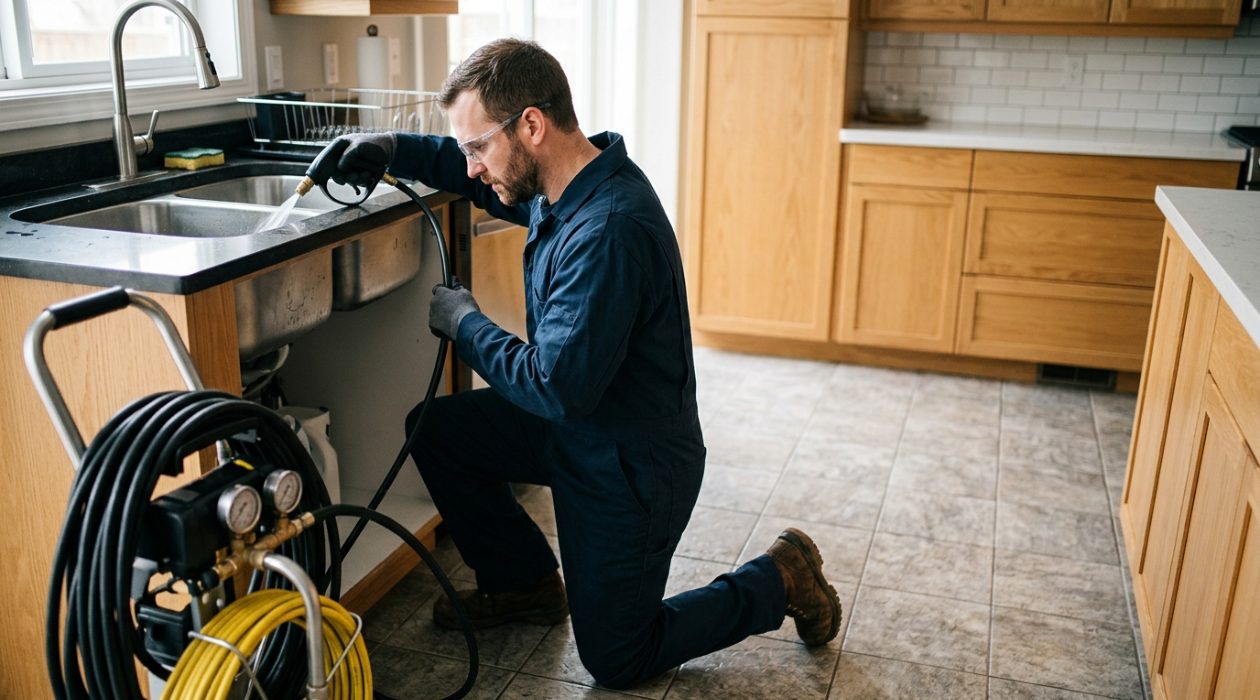
A cable punches a hole through a blockage. Jetting takes the pipe back to its full diameter: grease, scale and root hair off the wall entirely. Which is why the same line stops blocking every few months.
(970) 973-0235Picture a four-inch lateral with a half-inch of hardened grease around the inside. A cable drills through the middle and water flows again: the house works, the call is over, and the pipe still has a half-inch of grease around the inside. Every fiber, wipe and coffee ground that passes through finds something to catch on, and in a few months you’re back to where you started.
Jetting attacks the deposit rather than the hole. The nozzle’s rear-facing jets sweep the full circumference as the hose is withdrawn, cutting the material off the wall and flushing it downstream. You end up with the diameter the pipe was built with, which is the only version of “clear” that lasts.
That said, jetting is not the answer to everything, and a plumber who offers it for every blocked drain is selling rather than diagnosing. It excels on soft, extensive deposits: grease, sludge, scale, fine root hair. It’s a poor first choice against a solid object, and it’s actively the wrong choice on a pipe that has already failed structurally. Knowing which of those you have is what the camera is for.
If a drain has been cleared more than twice, jetting plus a camera usually ends the cycle.
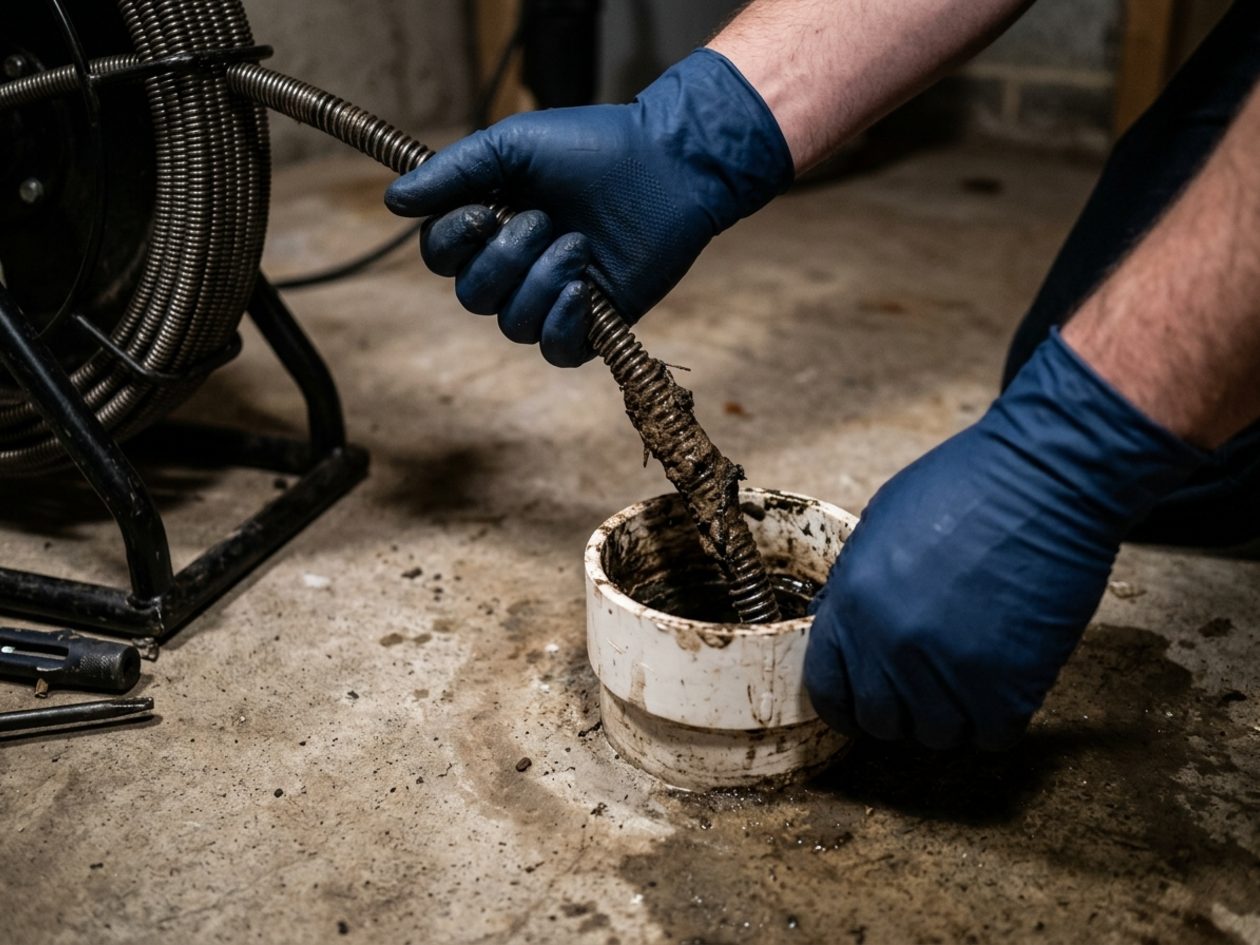 Flow restored, pipe still coatedThe reason a cabled line reblocks in the same spot
Honest scoping matters more here than on almost any other service, because the wrong call can turn a cleaning job into a repair job.
Why we keep insisting on the camera: jetting doesn’t weaken sound pipe, but it will find the weak spot in a pipe that was already failing, and if that happens, you’ve bought an excavation instead of a cleaning. Ten minutes of camera work beforehand tells the plumber the material, the wall condition and whether there’s a defect, and it protects you far more than it protects them.
Camera down the line first. Material, wall condition, defects, and the footage of anything that matters. This decides whether jetting happens at all.
Pressure, flow and nozzle chosen for that pipe and that deposit. A grease nozzle, a root nozzle and a penetrating nozzle do different jobs.
Hose fed from the cleanout to the far end, then withdrawn under pressure so the wall is scoured on the way back. Several passes where the deposit is heavy.
Camera again, so you can see clean pipe wall rather than take someone’s word for it, plus a straight answer on what maintenance the line needs.
Jetting strips roots out completely, but it doesn’t change why they came in. If the camera shows an open clay joint under a mature cottonwood, you have two legitimate options: maintain the line on a cycle, or repair that section and stop paying for it.
Both answers are valid. An older line with one active root point under a tree you don’t want to lose can be a managed condition for years. What matters is that you choose it knowingly, with footage in front of you, instead of discovering it as a recurring bill.
Nobody can quote hydro jetting accurately over the phone, and any company that gives you a firm figure before seeing the line is either padding it heavily or planning to revise it in your driveway. What an honest estimator needs to know first is where the machine can get in, how long the run is, what the pipe is made of, and what is actually coating the wall. Those four answers move the price more than anything else.
Access is the biggest single factor. A ground-level cleanout in an unfinished basement or an accessible exterior cleanout means the hose goes straight in and the job is measured in hours. No cleanout at all means pulling a toilet, going through a roof vent, or installing a cleanout before the real work starts, and installing one is a separate small excavation with its own cost. A surprising number of older Greeley houses have no exterior cleanout, so it is worth checking before you gather quotes.
Length and diameter come next. A thirty-foot kitchen branch and a ninety-foot lateral running out to the main are different machines, different nozzles, and different amounts of time. Deposit type matters too: soft grease flushes quickly, while hardened scale in old cast iron or a compacted root mass needs multiple passes and sometimes a cutting nozzle before the flushing nozzle can do its work.
Then there is the camera. Treat an inspection as part of the job rather than an upsell; it is what tells you whether jetting is safe on this particular pipe, and it is the only way to prove afterwards that the line is genuinely clean rather than merely flowing. Some companies bundle it, some price it separately and credit it against the work. Either is reasonable. What is not reasonable is jetting an unknown sixty-year-old lateral with no footage before or after.
Finally, ask what happens if the camera finds a structural fault instead of a deposit. A fair answer is that jetting stops, you pay for the inspection and the time on site, and the conversation turns to repair. Get that in plain language before anyone starts a machine.
Tell us whether you have a cleanout and roughly how old the house is, that alone narrows the estimate considerably.
The step that comes first, and the one that proves the result.
See details →Fixture and branch work, where cabling is often the better tool.
See details →Cutting the main root mass before the line is scoured.
See details →The emergency that jetting usually follows.
See details →When the camera shows a defect rather than a deposit.
See details →Lining a root-prone section so it stops needing maintenance.
See details →Root-scoured clay lines that a cable only reopens for a season.
Area details →Scale-lined cast iron, where cutting the deposit back matters more than clearing it.
Area details →Long shallow runs that hold grease along the whole length.
Area details →Restaurant and rental lines that need scouring on a schedule.
Area details →Not on the list? We cover Greeley, Weld County and the northern Front Range, see every service area.
Water at high pressure, delivered through a hose with a specialized nozzle that fires most of its jets backwards. Those rear jets do two things at once: they propel the hose up the pipe against the flow, and they scour the pipe wall on the way back out. The result is a line cleaned to its original diameter rather than bored through. Pressure and flow are matched to the pipe; this is not a pressure washer with a long hose, and the nozzle selection matters as much as the machine.
A cable is a mechanical tool: it drills, cuts or retrieves at one point. That restores flow quickly, which makes it the right choice in an active backup when the priority is getting the house usable. But it leaves the pipe wall coated: grease film, scale, root hair, so the bore is still narrowed and the next blockage forms in the same place. Jetting removes the coating itself. Snaking is the ambulance; jetting is the treatment.
Not when it’s specified correctly, and that qualifier is the whole answer. Sound PVC, ABS, copper, cast iron and clay all tolerate jetting at appropriate pressure. What jetting can expose, not cause, but expose: is a pipe that was already failing: badly corroded cast iron with paper-thin walls, deformed Orangeburg, or clay with sections already cracked. This is precisely why a camera inspection should come first. A plumber who wants to jet a sixty-year-old line without looking at it is guessing with your money.
Grease-laden kitchen and restaurant lines, where the deposit is soft but extensive. Scale build-up in older cast iron. Fine root hair after the main root mass has been cut. Silt and sediment settled in a belly. Any line that reblocks on a predictable cycle after cabling. And commercial kitchens as scheduled maintenance rather than reaction. It is the wrong choice as a first response to a solid object, and it is the wrong choice on a structurally failed pipe: that needs repair, not cleaning.
It removes them thoroughly but it doesn’t kill the tree, and the roots will return: they came in because there’s water and nutrient at that joint, and that hasn’t changed. The usual sequence is a cutting head to take out the main mass, then jetting to strip the fine hair back to the pipe wall, then a camera to see how the root got in. If the entry point is an open clay joint or a crack, you’re choosing between periodic maintenance jetting and repairing or lining that section permanently.
A residential lateral is usually one to three hours including setup, jetting and a verification camera pass. Add time where access is awkward, where the line is long, or where there’s a heavy grease deposit that needs several passes. Commercial kitchen lines can take longer simply because there’s more to remove. It’s a single-visit job in almost all cases, and you’ll have use of the house again the same day.
Before and after, ideally, and it’s worth insisting on. Before, because it tells you what you’re cleaning and whether the pipe can take it: that’s a safety check on your property, not an upsell. After, because it verifies the line is actually clean to the wall and documents the pipe’s condition for the future. Jetting without a camera is working blind at both ends of the job, and it removes the only evidence that the work achieved anything.
Only when there’s a reason. A sound line with no history needs nothing. A line with established roots at a joint you’ve decided to manage rather than repair typically runs on a one-to-three-year cycle, set by what the camera showed. A commercial kitchen might be quarterly or twice a year. Residential kitchen lines with a long grease history often settle at every two to three years. What you shouldn’t accept is an arbitrary annual schedule with no camera evidence behind it.
It depends entirely on the pipe, which is why the camera comes first. A lot of housing here has clay-tile or cast-iron laterals, and those two age very differently: clay tends to fail at the joints while the barrel stays sound, cast iron corrodes from the inside until the wall thins. Both can be jetted safely in good condition and neither should be jetted blind. Where the camera shows a compromised section, the honest recommendation is repair or lining rather than cleaning a pipe that’s near the end of its life.
It depends on access, run length, pipe material and what is coating the wall, so a firm number before anyone sees the line is not a real number. A straightforward job through an existing cleanout on a modern lateral sits at the low end; no cleanout, a long run, hardened scale or a heavy root mass all push it up, and installing a cleanout is a separate small excavation. Ask for the camera inspection to be quoted alongside it, and ask what happens to the price if the footage shows a broken pipe rather than a dirty one. Any company willing to put those conditions in writing before starting is quoting honestly.
Tell us how often the line has blocked and what came out last time.
Hydro jetting with before-and-after camera work across Greeley, Evans, Windsor and Weld County.
(970) 973-0235Answered 24 hours a day, seven days a week, every week of the year.