Clay tile laterals
Pre-1960s houses were plumbed with short clay sections, which means a joint every few feet. The barrel often survives a century in good order, but every one of those joints is a potential entry point.
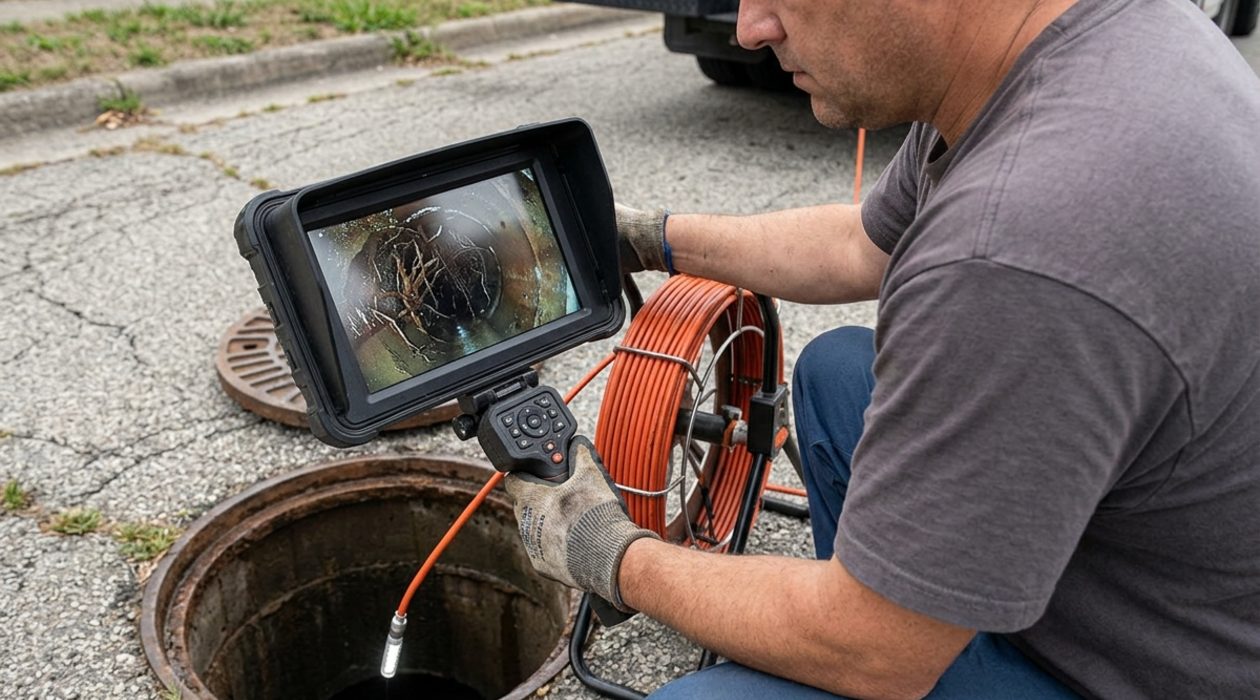
Cottonwood and elm roots find every open joint in an old clay lateral. We clear the mass, scour the wall back to bare pipe, then show you the entry point so you can choose between managing it and ending it.
(970) 973-0235It’s a useful thing to understand, because it reframes the whole problem. A sewer lateral carries warm water and nutrient. Any imperfect joint or hairline crack lets a trace of that escape into the surrounding soil as vapor. In the dry ground typical of the northern Front Range for much of the year, that plume is the most attractive thing in the neighborhood for a moisture-seeking root system.
A root hair fine enough to pass through a gap you’d struggle to see enters, finds ideal growing conditions, and branches. Over seasons it thickens, and a thickening root under growth pressure levers a joint further open or widens a crack. Within a few years there’s a dense mat spanning the bore, catching every fiber and solid that passes.
Which is why the sequence matters. Cutting the mass out restores flow but changes nothing about the invitation. Jetting removes the fine hair from the wall so regrowth starts from bare pipe rather than from an established felt. And repairing or lining the entry point is the only thing that actually revokes the invitation. Any of those three can be the right stopping point for your situation, but you should know which one you bought.
If this line has blocked before, tell us roughly when, the interval is diagnostic.
 It starts at a jointFine hair through a gap you couldn’t see
Pre-1960s houses were plumbed with short clay sections, which means a joint every few feet. The barrel often survives a century in good order, but every one of those joints is a potential entry point.
Decades of cottonwood, elm and silver maple planting along the older grid, often directly between the house and the main. Root systems commonly reach two to three times the canopy spread.
A semi-arid climate makes a leaking sewer joint the most reliable moisture source in the ground. The drier the surrounding soil, the stronger the incentive for roots to travel toward it.
Seasonal swelling and shrinking pulls rigid jointed pipe out of alignment, creating exactly the small openings roots need. The soil and the trees work together.
Lawn watering encourages shallow, wide root development across the front yard, precisely the zone the lateral runs through.
Backups cluster in spring, when saturated ground adds infiltration volume to a line already narrowed by root growth. A line that copes in January fails in April.
After that, the choice is yours and both answers are defensible: schedule the next clear-and-jet on a known interval, or repair the entry point: typically by lining that section, which removes the joints altogether. What we’d push back on is doing stage one repeatedly, for years, without ever doing stage three.
Ask what came out. Fine hair, a thick mass, or pipe fragments all mean different things.
If a line is being cleared every eighteen months, add up five cycles, plus the emergency-rate call that eventually happens on a holiday weekend. Compare that with lining the affected section. Sometimes maintenance still wins. Often it doesn’t, and nobody has ever laid the numbers side by side.
And before you plant anything. Have the line located and marked. Knowing where the lateral runs is the difference between a tree that shades your house for forty years and one that becomes a standing appointment with a drain machine.
Clearing a root mass is satisfying and slightly deceptive. The house drains properly again, the gurgling stops, and it is very easy to treat the problem as solved. It is not solved; it is reset. Roots entered through a defect, that defect is still there, and the same tree is still looking for the same water. What you do in the following week determines whether you are back in eighteen months or not for a decade.
First, get the footage and actually watch it with the plumber. You are looking for one thing above all: what kind of opening let the roots in. A slightly separated clay joint, a hairline crack, a bad tap connection and a section of collapsed pipe are four different futures. A joint that has opened a few millimetres may be a good lining candidate. A collapsed section is a dig. Being told “roots” without being told where they entered is not a diagnosis.
Second, decide deliberately between maintenance and repair, and do the arithmetic rather than the feeling. Recurring clearing has a real annual cost, and if the interval is short enough, several years of it will exceed the price of fixing the defect once. Maintenance is a legitimate choice: for an older homeowner planning to sell, or a line with several other problems that will all be addressed together later, but it should be a choice you made, not a default you drifted into.
Third, be realistic about the tree. Removing it is rarely necessary and rarely the cheapest option once you price the removal and the loss of shade. Root barriers help in specific situations and are useless in others. The reliable fix is almost always to make the pipe watertight, because a sealed line offers nothing worth growing towards.
Finally, note the date. Root intrusion is seasonal here, and knowing that your line closed up in late summer two years running tells you when to schedule the next camera check rather than waiting for the basement to tell you.
Ask where the roots entered, not just that they were there, that single answer decides repair or maintenance.
The scouring stage that makes a clearing last.
See details →Finding the entry point and the pipe’s real condition.
See details →Lining a section so there are no joints left to enter.
See details →Replacing pipe where roots have done structural damage.
See details →The symptom that brings most people to this page.
See details →Branch and fixture work inside the house.
See details →Mature street trees directly over clay laterals with open joints.
Area details →Old plantings and old pipe in the same narrow lots.
Area details →Cottonwood and elm roots that find a joint and keep coming back.
Area details →Repeat backups that are a root problem being treated as a grease one.
Area details →Not on the list? We cover Greeley, Weld County and the northern Front Range, see every service area.
They follow moisture and nutrient to an existing weakness. A sewer line leaks a small amount of warm, nutrient-rich vapor at any imperfect joint or hairline crack, and in dry soil, which describes most of the Front Range for much of the year; that is an extremely attractive target. A root hair fine enough to pass through a gap barely visible to the eye enters, finds ideal conditions, and thickens. So roots almost never break a sound pipe; they exploit and then enlarge a defect that already existed.
Cottonwood is the usual answer: fast-growing, water-seeking, and widely planted along the Poudre and Platte corridors and throughout the older neighborhoods. Siberian and American elm are close behind, along with silver maple, willow and poplar. Species matters less than proximity and behavior: any large, fast-growing, moisture-seeking tree within reach of the line is a candidate, and root systems commonly extend well beyond the canopy, often two to three times the branch spread.
Usually not, and it’s rarely the first recommendation. The productive approach is to fix the pipe rather than remove the tree: line the affected section so there are no joints to enter, or replace that length with continuous modern pipe. A jointless pipe with sound walls doesn’t leak the moisture that attracts roots and offers nothing to grow into. Removal only really enters the conversation when a trunk sits directly over the line, when the root plate is actively displacing the pipe, or when the tree is in poor condition anyway.
Slow drainage across several fixtures rather than one. Gurgling from a basement floor drain or a toilet when a large volume goes down elsewhere. Toilets that empty sluggishly with no local blockage. Backups that arrive during wet periods and ease when the ground dries. A recurring blockage at roughly the same interval: roots regrow at a fairly predictable rate, so a line that blocks every autumn is telling you something specific. And unusually lush or soggy grass in a line over the route.
Foaming root treatments containing an appropriate herbicide can slow regrowth inside the pipe, and they’re a legitimate part of a maintenance program once the mass has been mechanically removed. They are not a substitute for that removal, they don’t repair the defect that let roots in, and they can’t restore a joint that has been levered apart. Products should be used strictly per label and with regard for what they discharge into. Rock salt and homemade remedies are ineffective and can harm the pipe, the tree and the treatment works.
Mechanically, in two stages. A cable with a cutting head sized to the pipe shears the mass and restores flow, that’s the part that gets the house working. Then hydro jetting scours the remaining fine hair off the pipe wall, back to the original diameter, which a cutter alone cannot do. A camera pass follows to see the entry point clearly, now that the obstruction is gone. Skipping the jetting stage leaves a felt of fine root on the wall, which regrows noticeably faster than bare pipe.
It depends on species, moisture and how completely the previous removal was done, but a cleared line with an unrepaired entry point typically needs attention again somewhere between one and three years. Cut-only jobs tend toward the shorter end; properly jetted lines toward the longer. That interval is the crux of the decision: if you’re clearing every eighteen months indefinitely, the cumulative cost usually exceeds lining or replacing the affected section within a few cycles.
Genuinely, yes, and it’s worth saying plainly, because the alternative advice is usually to sell a repair. If the camera shows one active root point in otherwise sound pipe, the tree is valuable to you, and the interval is two or three years, a scheduled clear-and-jet is a reasonable, informed decision. What makes it reasonable is knowing the pipe’s condition and choosing deliberately. What makes it unreasonable is repeatedly paying emergency rates for backups because nobody ever put a camera down.
Yes, and this is the cheapest intervention available. Find out where the lateral runs before planting anything substantial, a camera survey with a sonde locate marks it on the ground. Keep large, fast-growing, moisture-seeking species well away from that corridor, and prefer smaller ornamental species nearby. Root barriers installed along the line can help. And if you have a sound modern PVC lateral, the risk drops enormously simply because there are far fewer joints to exploit.
Standard policies generally exclude damage to the sewer lateral itself, on the basis that root intrusion is gradual and treated as a maintenance issue rather than a sudden event. What is often covered, sometimes only through a separate water backup or service line endorsement, is the damage a resulting backup causes inside the house: flooring, drywall, contents and cleanup. Those endorsements are usually inexpensive and worth asking about before you need them. Keep the camera footage and the invoice either way: if you do file, documentation of the condition and the date is what makes the claim straightforward.
Tell us what trees are near the line and how often it has blocked.
Root cutting, jetting and camera work across Greeley, Evans, Windsor, Eaton and the Weld County communities.
(970) 973-0235Answered 24 hours a day, seven days a week, every week of the year.