Full flush
Drained until it runs clear, with the sediment bed agitated where it’s heavy rather than left to settle back. On a long-neglected tank this is the part that takes the time.
In this water, an annual flush and an anode check are the difference between a heater that reaches twelve years and one that quits at eight. It’s an hour’s work and almost nobody books it.
(970) 973-0235Every gallon of hard water heated leaves a little calcium and magnesium behind. It settles to the bottom of the tank and hardens into a gray crust, and once there it does four separate kinds of damage, which is why this one hour of maintenance carries such disproportionate value in northern Colorado.
It steals capacity. The scale bed physically occupies volume. A 50-gallon tank with several inches of sediment behaves like a considerably smaller one, which is usually the first thing a household notices: hot water that used to be plentiful now runs out.
It wastes fuel. On a gas heater the burner sits underneath, so the scale layer is directly between the flame and the water. Heat has to conduct through it, the burner runs longer for the same result, and that inefficiency appears on the bill every month for years.
It makes noise. Water trapped beneath the sediment superheats and forces its way up through it, the rumbling and popping people describe. It’s harmless in itself and an unmistakable signal about what’s inside.
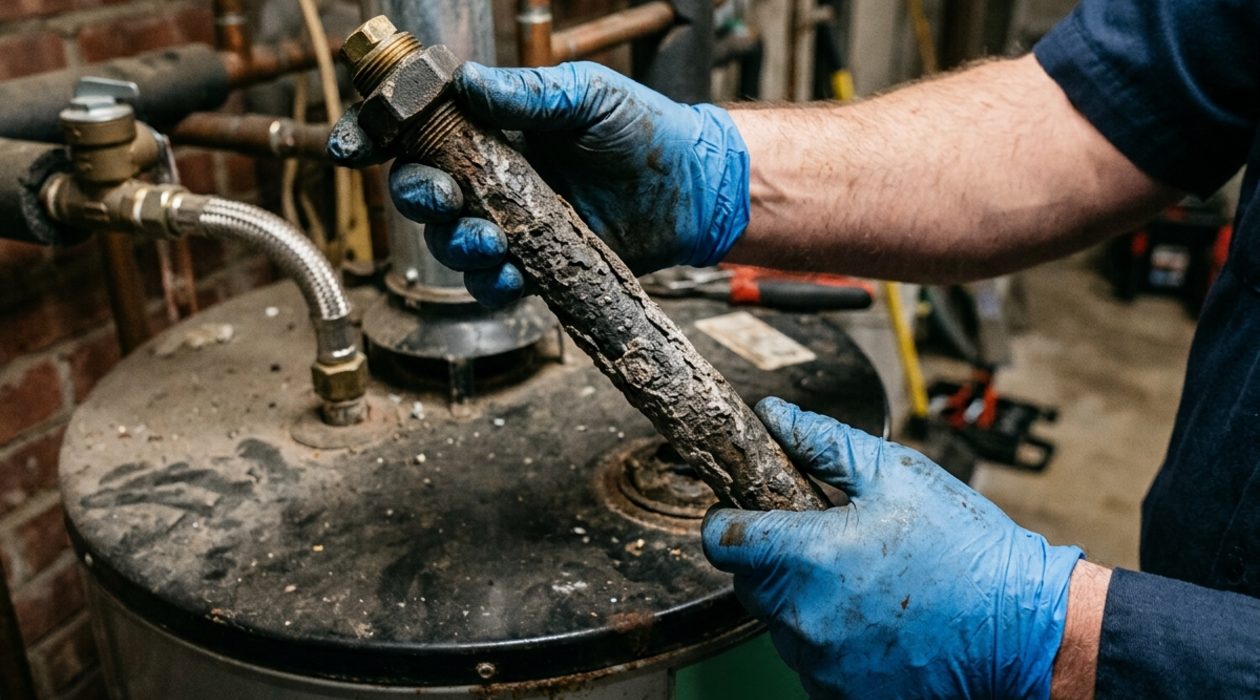
It shortens the tank’s life. The layer holds heat against the steel base and creates conditions that accelerate corrosion, while the depleted anode rod that usually accompanies neglect removes the tank’s protection at the same time. The two together are why so many heaters here fail well short of their rated years.
Rumbling from the tank? That’s the symptom this visit addresses.
What comes out Gray grit and cloudy water, until it runs clear
Drained until it runs clear, with the sediment bed agitated where it’s heavy rather than left to settle back. On a long-neglected tank this is the part that takes the time.
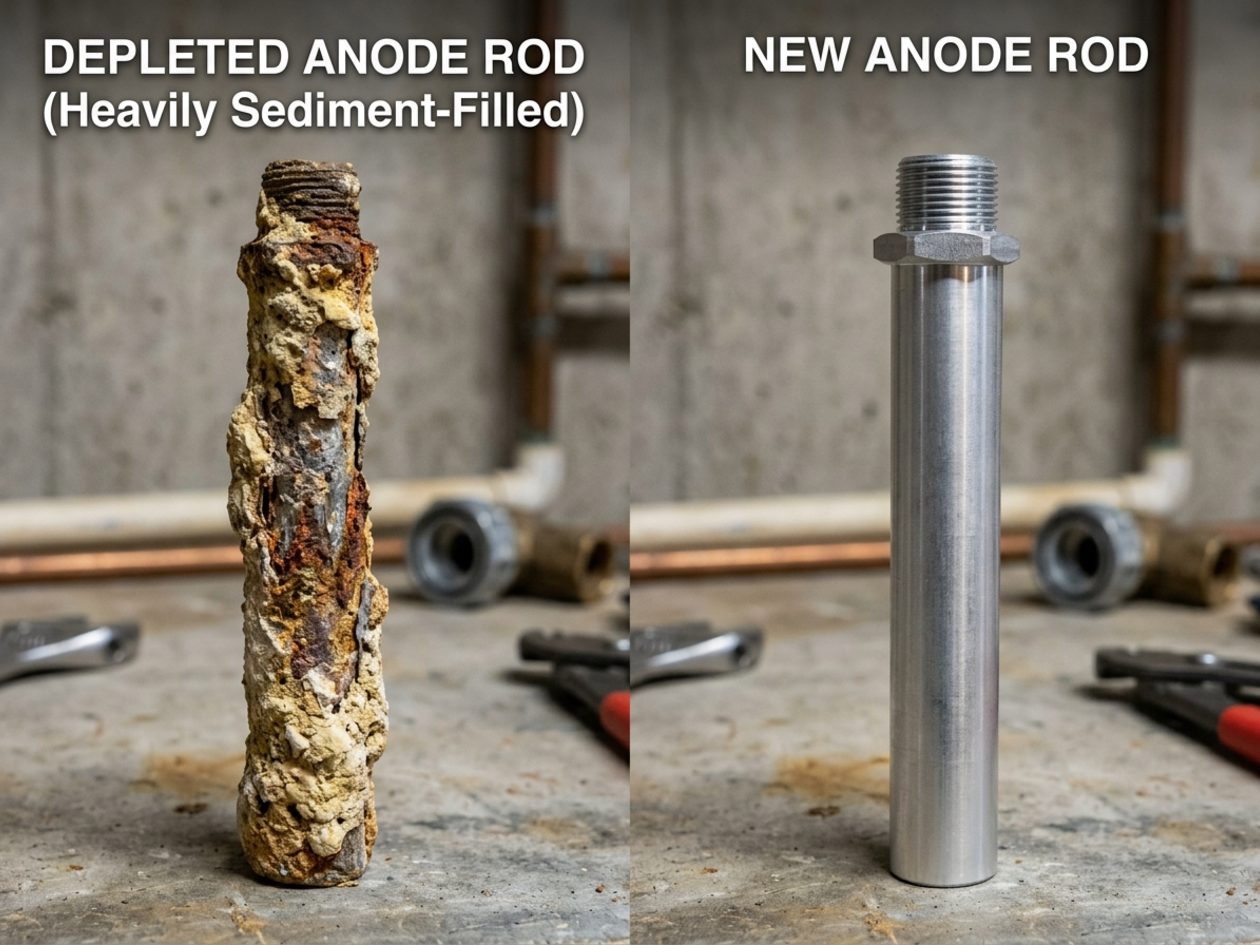
Pulled, inspected, replaced when spent. The highest-value item on the list and the one most often skipped entirely.
Tested, and its discharge pipe checked for correct routing and termination. This is the tank’s primary safety device, not an optional extra.
Actual delivered temperature measured rather than read off a dial, and set to a sensible figure around 120°F for safety, efficiency and slower scale formation.
Burner condition and flame pattern on gas; element and thermostat resistance on electric. Small faults found here are cheap; found later they aren’t.
Correct material, support and termination, with draft confirmed. The safety-critical part of any gas appliance.
Pre-charge checked against house pressure. A failed expansion tank quietly stresses the heater, the relief valve and every supply line in the house.
A five-minute measurement that occasionally explains years of odd failures: dripping relief valves, worn cartridges, burst appliance hoses.
Fittings, unions, drain valve and tank base examined for seepage and rust staining, so a replacement gets planned rather than sprung on you.
A flush is cheap, which makes it easy to sell on any tank at all. There are cases where it genuinely isn’t the right call, and you should hear them:
Where maintenance pays for itself many times over is on a heater that is sound: anything in its first eight years, anything already on a schedule, and above all a brand-new installation. The best time to start is the year you put the tank in, not the year it starts making noise.
Tell us the age and whether it has ever been flushed. That decides the recommendation.
The most valuable flush is the first one, on a tank with nothing in it yet. Households that begin maintenance in year one routinely get years past the rated life; households that start in year nine are usually just documenting the decline.
If you own a tankless unit, this is not optional. Descaling annually is the condition on which its twenty-year life expectancy rests, and neglect shows up as lost output and fault codes rather than a gradual decline.
A flush is one of the few plumbing jobs a careful homeowner can genuinely do, and we would rather you did it well than not at all. But the failure modes are specific, and two of them can turn a free Saturday task into a paid emergency. Knowing them in advance is most of the skill.
The drain valve is the risk. Most tanks ship with a plastic valve that has sat untouched for years, with sediment packed against it. Opening it is easy. Getting it to seal again afterwards is where people get caught, because a grain of sediment lodges in the seat and it weeps continuously. If your tank is more than about eight years old and has never been flushed, assume the valve may not close, and know where the cold water shut-off above the tank is before you touch anything.
Sequence matters. Kill the gas control to pilot or switch off the electric breaker first: heating elements exposed by a dropping water line burn out in seconds, and that turns a flush into an element replacement. Let the tank cool for an hour or two before draining; scalding is the other common injury here. Open a hot tap upstairs to break the vacuum so the tank actually drains instead of gurgling.
Cloudy water is not the finish line. On a tank that has never been done, the first flush often runs clear while a hard shelf of scale stays sitting on the bottom. Briefly opening the cold supply with the drain still open stirs the base and carries more of it out. Repeat until the discharge stops changing.
Know when to stop and call. If the water never clears, if the drain slows to a trickle and stops, if the valve will not reseal, or if you find rusty water rather than gray sediment, the tank is telling you something a flush cannot fix. Rust means the lining is compromised, and continuing is not useful.
What a homeowner flush does not cover is the rest of the annual check: the anode rod, the relief valve, combustion and draft, the expansion tank and house pressure. Those are the items that actually extend the life of the appliance, and they are the reason a service visit is worth more than the flush alone.
Happy to talk you through a DIY flush on the phone, and to come out if the valve will not reseal.
When maintenance finds something that needs fixing.
See details →Planned replacement, on your schedule.
See details →Removing the mineral before it reaches the tank.
See details →Where descaling becomes non-negotiable.
See details →The quiet cause of dripping relief valves and worn cartridges.
See details →Whole-house treatment options.
See details →Hard water and builder-grade tanks, which scale quickly together.
Area details →Ten-year-old heaters installed with the house, all aging at once.
Area details →Tanks in their back half, where a flush buys real time.
Area details →Anode checks on heaters nobody has looked at since installation.
Area details →Not on the list? We cover Greeley, Weld County and the northern Front Range, see every service area.
Annually is the standard recommendation and in this water it’s a genuine minimum rather than a cautious suggestion. Northern Colorado’s mineral content means a tank accumulates scale faster than it would in a soft-water region, so a heater flushed every year in Greeley is roughly comparable to one flushed every two or three years elsewhere. Households with high hot water use, or a heater already several years into a neglected life, benefit from twice yearly for the first couple of visits.
Yes, and it’s a reasonable homeowner job on a tank that has been maintained: shut off the gas or breaker, close the cold inlet, connect a hose to the drain valve, open a hot tap upstairs to let air in, and drain until the water runs clear. Two cautions. The water is scalding, so treat it accordingly. And on a tank that has never been flushed, sediment often blocks the drain valve or the old plastic valve simply fails when turned, which turns a maintenance task into an unplanned repair. If the heater is more than a few years into neglect, have the first one done professionally.
Then there’s more sediment than a gravity drain can move, which is common on a tank that has gone years without attention. A plumber can agitate the sediment bed, stirring it up with a wand or a hose fed into the tank so it draws out rather than settling back, and repeat the drain until it clears. Occasionally a tank is so heavily silted that flushing achieves little; at that point the honest answer is that the flush is not going to recover it and the money is better aimed at replacement.
It depends where the tank is in its life and what it’s doing. On a heater of eight or nine years that has been flushed regularly, absolutely, keep going. On a twelve-year-old tank that has never been flushed, is rumbling loudly, and gives rusty hot water, flushing can occasionally disturb a sediment bed that was doing an accidental job of sealing a corroded base, and it will not restore lost capacity. That’s a case for planning a replacement rather than servicing it.
A sacrificial rod inside the tank designed to corrode instead of the tank lining. Once it’s consumed the tank itself becomes the sacrificial component, which is exactly how tanks fail. In hard water it depletes faster, so inspection every two to three years and replacement when spent is the single highest-value item on a water heater. It costs a small fraction of a tank and can add years of life. Almost nobody does it, which is a large part of why heaters here fall short of their rated lifespan.
The flush is the headline, but the rest is where problems get caught early. Anode rod inspection. T&P relief valve test and a check that its discharge pipe is correctly routed and unobstructed. Thermostat setting confirmed, usually around 120°F. Burner and flame pattern on a gas unit, or element and thermostat resistance on an electric one. Venting and draft. Expansion tank pre-charge. Signs of corrosion or seepage at the fittings and base. And a look at household water pressure, which quietly drives a lot of failures.
More than a tank does, and it’s not the same procedure. Tankless maintenance is descaling: circulating an approved solution through the heat exchanger with a pump, plus cleaning the inlet filter and checking venting. In hard water, annually at minimum. Because the passages are narrow, scale has a much larger proportional effect than in a tank, so where a neglected tank simply gets worse at its job, a neglected tankless unit loses output and starts throwing fault codes.
Modestly and measurably. A sediment layer insulates the burner from the water, so the burner fires longer to reach the same temperature and you pay for the difference every month. Removing it restores the heat transfer the appliance was designed around. Nobody should promise dramatic savings from a flush, but combined with a sensible thermostat setting and a functioning expansion tank it makes a real difference over a year, and the larger saving is the replacement you deferred.
Somewhat, and around 120°F is the usual balance point. Scale formation accelerates at higher temperatures, so a tank running at 140°F builds it faster, and it also carries a genuine scald risk and wastes standby energy. Going too low has its own trade-off, since very low storage temperatures can encourage bacterial growth in a tank. Around 120°F is the widely recommended compromise, and it’s worth having a plumber confirm the actual delivered temperature rather than trusting a dial.
This is the most common way a DIY flush goes wrong, and it is almost always sediment caught in the valve seat rather than a broken valve. Try opening it fully once more to let the flow clear the obstruction, then close it firmly but without forcing, plastic valves crack easily. If it still weeps, shut off the cold supply above the tank, which stops the leak while you arrange a repair.
Replacing a tank drain valve is a small job, and it is worth fitting a full-port brass one instead of the plastic original so that next year's flush drains faster and seals properly. If the tank is already near the end of its service life, put the money toward replacement instead.
Age of the tank, and whether it has ever been flushed, those two answers are enough.
Water heater flushing, anode replacement and tankless descaling across Greeley and Weld County.
(970) 973-0235Answered 24 hours a day, seven days a week, every week of the year.