Hose left attached over winter
The single biggest cause. Trapped water in the frost-free stem freezes and splits the tube inside the wall. Costs nothing to prevent and hundreds to repair.

A hose bib that drips, sprays at the handle or leaks only when you open it is telling you something specific, and one of those symptoms means water is already running inside your wall.
(970) 973-0235There is one hose bib symptom that is genuinely urgent, and it is easy to miss because it looks minor. A frost-free sillcock that stays dry when closed but produces water: from the wall, from the siding, from the basement ceiling below, only while it is running has almost certainly split inside the wall.
Here is why. A frost-free bib is a long tube, typically eight to twelve inches, with the actual valve seat at the far inside end where the house is warm. When you close the handle, the tube ahead of the seat drains out through the spout and holds no water, which is what makes it frost-free. If that tube freezes and splits, which happens when a hose is left attached and traps water in it, the crack is behind the seat. Closed, no water reaches it, so nothing leaks. Open, and pressurized water pours out of the split into your wall cavity, floor joists or basement.
People run these for a whole spring wondering why the drywall in the basement is staining. Shut the valve, do not use that bib, isolate it at the interior shutoff if one exists, and call. This is a repair worth doing this week, not this season.
A drip from the spout when the handle is closed is the ordinary version of the same fixture and it is not urgent. Worth fixing, not worth panicking about.
Water only while running means a split behind the wall. Same-day where we can.
A standard compression bib is the short one. The valve seat is right behind the handle, inches from the outside air, and the whole body holds water when closed. On any Colorado wall this is a freeze waiting to happen, and it is why these need a dedicated interior shutoff and an autumn drain-down every single year without exception.
A frost-free sillcock puts the seat at the far end of a long stem, inside conditioned space. Close it and the exposed section self-drains. It is the correct fixture for this climate, and if you are replacing anything on an exterior wall, replace it with one of these.
Frost-free has one non-negotiable condition though: the bib must be pitched slightly downward toward the outside so it can actually drain, and nothing can be attached to the spout. A hose left on over winter, or even a quick-connect fitting with a shutoff, traps the column of water in the tube. It freezes, expands, and splits the tube inside the wall, the exact failure described above. Every frost-free bib we replace after a freeze had something screwed onto it in October.
Both types now typically carry an integral vacuum breaker on the spout to stop hose water siphoning back into the supply. That little cap is a backflow device, and it has its own failure mode.
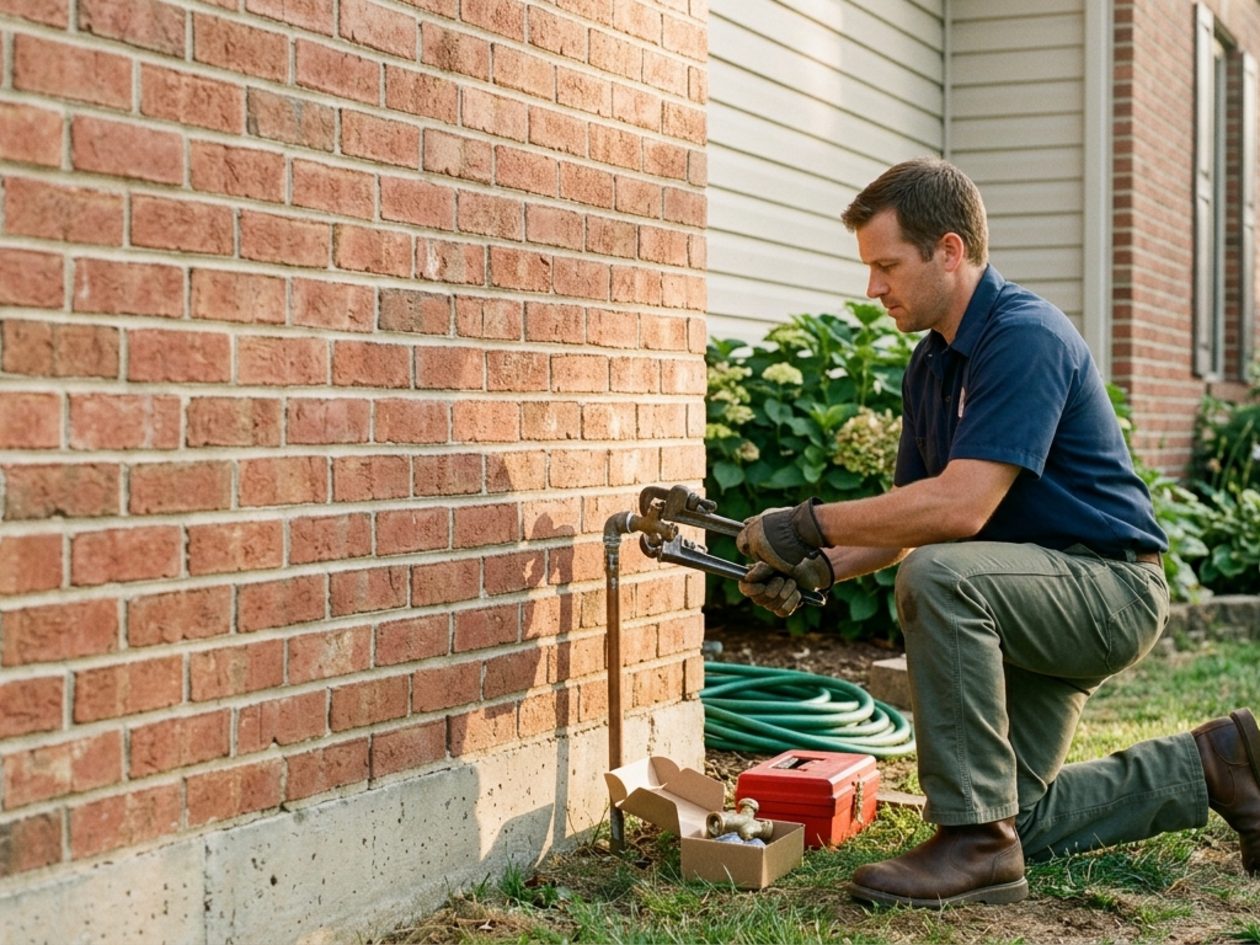 Seat at the warm endFrost protection comes from the stem length and the downward pitch. Neither works with a hose left attached.
Dripping from the spout when closed. The washer or seat seal at the valve end has worn. On a frost-free that means pulling the whole stem out through the front, replacing the washer at its tip, and checking the seat for pitting. Straightforward, and possible without opening any wall.
Spraying or weeping from around the handle when open. The packing nut or the o-ring behind it has failed. Often solved by snugging the packing nut a quarter turn; if not, the packing washer is replaced. Cheap, quick, and worth doing before the constant wetting corrodes the stem.
Continuous drip from the vacuum breaker cap on top. The little check inside has stuck or its o-ring has hardened. Repair kits exist for most brands and the cap assembly can usually be replaced on its own without touching the rest of the fixture.
Water from the wall, siding or basement only while running. Split stem inside the wall, as above. Not repairable from outside: the fixture is replaced, which may mean interior access.
Handle turns but nothing comes out. Either the interior shutoff is closed, the stem has sheared from its washer retainer, or the supply line to the bib froze and split somewhere upstream.
Most bib repairs are done from the outside in under an hour.
Streaks tell a story Mineral staining below a bib means it has been leaking for seasons, not days.
The single biggest cause. Trapped water in the frost-free stem freezes and splits the tube inside the wall. Costs nothing to prevent and hundreds to repair.
A frost-free bib installed dead level or tilted up cannot self-drain. It behaves like a standard bib and freezes the same way, no matter what the box promised.
Mineral deposits build on the valve seat until the washer cannot seal against it. Produces the classic slow spout drip that returns weeks after a washer change.
Older homes feed exterior bibs with galvanized pipe that rusts closed from the inside. Flow drops year on year until the bib barely trickles.
Cranking a stiff handle to stop a drip crushes the washer and scores the seat, converting a washer job into a full stem or fixture replacement.
The integral backflow cap on the spout sticks open after a few seasons of grit and freeze cycles, and dribbles continuously whenever the bib is used.
How hard a replacement is depends almost entirely on how the existing bib is joined to the supply behind it, and you cannot always tell from outside.
The easy case: the bib is threaded onto a female adapter and the supply is accessible from an unfinished basement or crawlspace. We isolate, unscrew, fit a new frost-free of the correct length with the right pitch, and test. An hour, no drywall.
The middle case: the bib is soldered to copper. That means cutting, cleaning and sweating a new joint, which needs access and a heat shield against the framing. Still usually done from inside an unfinished space.
The hard case: the connection is buried behind finished drywall or tile, or the supply is galvanized and has to be transitioned to copper or PEX with a dielectric fitting. Then we are cutting an access opening. We keep it small, place it where it can be covered by a plate or patched cleanly, and tell you before we cut, nobody gets a surprise hole.
Stem length matters and is the mistake most often made on DIY replacements. The frost-free stem must be long enough that the seat sits inside heated space. A four-inch bib on a wall with a thick insulated cavity puts the seat in the cold, and it will freeze exactly like a standard bib. We measure the wall rather than guessing.
We tell you the access needed before we start cutting anything.
Disconnect every hose. All of them, including the one on the side of the house you never use, and including quick-connect fittings and splitters left on the spout. This one act prevents the majority of frost-free failures we repair.
If your bibs are standard compression rather than frost-free, find the interior shutoff: usually a small valve on the supply line in the basement or crawlspace, often with a bleeder cap on its side. Close it, then go outside and open the bib fully to let the section between the two drain. Leave the outside handle open all winter. If the shutoff has a bleeder screw, open that too so nothing is trapped.
Insulated foam covers are cheap and worth fitting, with one caveat: they help a bib that is already drained and do very little for one still holding water. They are a supplement, not the plan.
While you are out there, look at the ground below each bib. Green algae streaking or a soft patch of soil against the foundation means the bib has been leaking for a while, and water against a foundation is a bigger problem than the fixture that caused it.
We handle this as part of autumn winterization visits alongside sprinkler blowouts, which is the natural time to do both.
That small brass cap on the end of a modern hose bib is an atmospheric vacuum breaker, and it exists because a garden hose is one of the highest-risk cross-connections on any property. A hose lying in a puddle, in a pool, or attached to a weed-killer sprayer becomes a direct path from contaminated water into your drinking supply the moment street pressure drops.
The breaker lets air in behind the water column so it cannot be siphoned back. It is a genuinely important little device and it is also a consumable: grit and freeze cycles eventually stick the poppet open, at which point it drips constantly whenever the bib runs, and no longer protects anything.
Most are replaceable as a unit. Some are held by a set screw designed to shear on installation so they cannot be removed casually, which is deliberate, and those need the correct replacement rather than improvisation.
If you use a hose-end sprayer for fertiliser or herbicide, do not rely on the hose bib breaker alone; that is exactly the scenario the code contemplates, and it is worth having the whole irrigation and outdoor water setup looked at properly.
A backflow device, not a cap When it dribbles continuously it has stuck open, and it is no longer protecting the supply.
Most homes here have two to four exterior bibs and at least one of them is neglected. Repairing a drip, replacing a stuck vacuum breaker and winterizing the lot in a single visit costs far less than the wall repair that follows a split stem.
If you are already booking a sprinkler blowout, add the hose bibs to it. Same trip, same crew, and the two jobs share the same deadline.
The other half of your autumn checklist, and the natural visit to bundle bib work into.
See details →Safe thawing and repair when the freeze has already reached the supply line.
See details →For a split that has already let go and is putting water into the structure.
See details →Annual testing for irrigation assemblies and higher-hazard connections.
See details →To trace water inside a wall back to its actual source before opening anything.
See details →When the corroded galvanized supply feeding the bib is the real problem.
See details →Bibs on north walls that freeze first and split behind the siding.
Area details →Yard hydrants and stock taps that matter more than the house tap does.
Area details →Long outbuilding runs with a single bib at the far end.
Area details →Farm properties where one frozen bib takes out the whole irrigation feed.
Area details →Not on the list? We cover Greeley, Weld County and the northern Front Range, see every service area.
Yes, and it is the one hose bib symptom we treat as urgent. It almost always means a frost-free sillcock has split inside the wall behind the valve seat. Closed, nothing reaches the crack; open, pressurized water pours into the wall cavity. Stop using that bib and call, every use is putting water into your structure.
Three usual reasons. A hose or quick-connect was left attached, trapping water in the stem. The bib was installed level or tilted upward so it cannot self-drain. Or the stem is too short for the wall thickness, leaving the valve seat in the cold cavity rather than in heated space. All three defeat the frost-free design entirely.
A spout drip on a simple bib is a realistic DIY job: shut off the supply, unscrew the packing nut, withdraw the stem, replace the washer at the tip. Two things go wrong: the seat is pitted so the new washer will not seal, or the stem seizes and shears. If it fights you, stop before you turn a washer job into a fixture replacement.
The fixture itself is inexpensive. The cost is access. A threaded bib with the supply reachable from an unfinished basement is a short visit. A soldered connection needs cutting and sweating. A connection behind finished drywall means an access opening, and we always tell you before cutting. We quote once we have seen how it is joined.
An atmospheric vacuum breaker, a backflow device that stops hose water being siphoned back into the drinking supply. When it drips continuously while the bib runs, the internal poppet has stuck. Most can be replaced on their own without touching the rest of the fixture.
If they are standard compression bibs, absolutely: close the interior shutoff, open the outside bib to drain the section between them, and leave it open all winter. If they are frost-free and correctly pitched, you mainly need to disconnect every hose. Doing that one thing prevents most of the freeze damage we repair.
That is the packing nut or the o-ring behind it. Often a quarter turn on the packing nut stops it. If not, the packing washer is replaced, which is a quick and inexpensive repair. Worth doing promptly, constant wetting corrodes the stem and the wall behind it.
On older homes the usual answer is a corroded galvanized supply line that has rusted nearly closed from the inside. It gets worse gradually so nobody notices until a sprinkler will not run. Less commonly it is a partly closed interior shutoff or a blocked vacuum breaker. We can tell which by checking pressure at the bib and upstream.
Usually yes. We tee off an existing supply, run new line to the wall, fit an interior shutoff with a bleeder, and install a frost-free sillcock of the correct stem length for that wall. How involved it is depends on how far the new location is from an accessible supply and whether the route crosses finished space.
They help, but only as a supplement. A cover on a bib that still holds water will not save it, the metal conducts cold straight through. Disconnect hoses and drain the line first; then a cover buys you a useful margin on the coldest nights.
Not sure which symptom you have? Describe it and we will tell you how urgent it is.
Hose bib repairs, frost-free replacements and autumn winterization.
(970) 973-0235Answered 24 hours a day, seven days a week, every week of the year.