Grit under the check seat
Our water carries sediment, especially after a main break or hydrant flushing. A single grain holding a check valve open drops the differential below spec. Often cleared by cleaning and reseating during a rebuild.
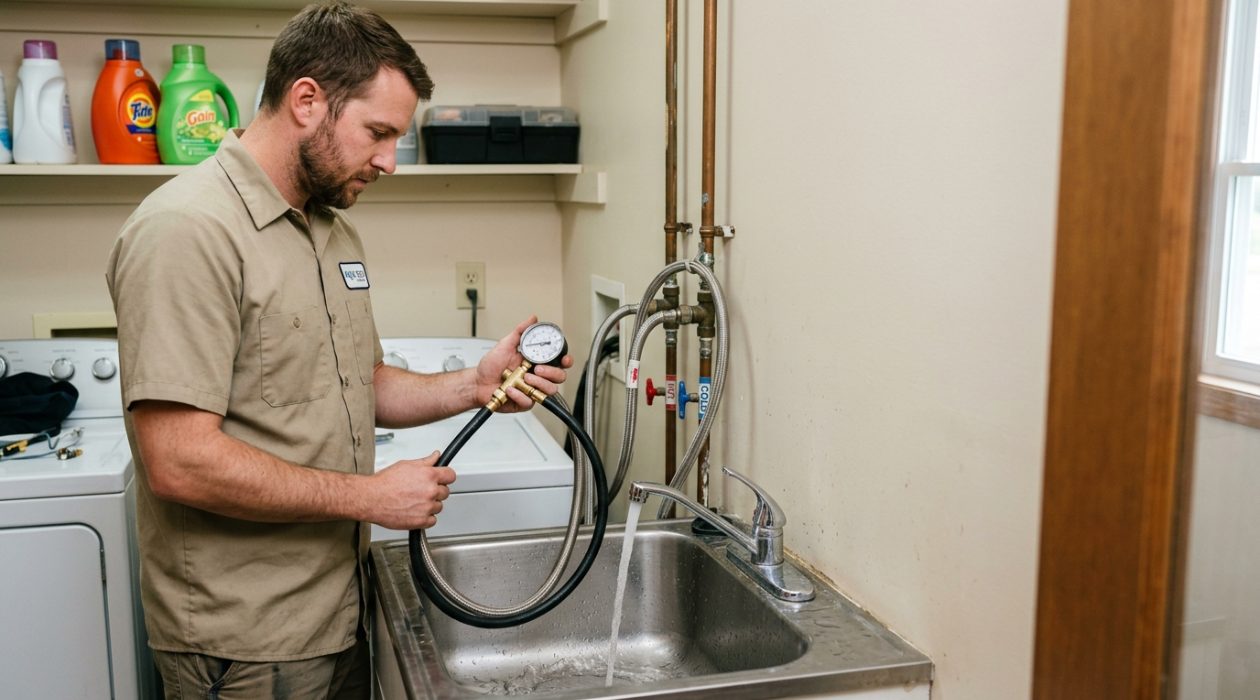
Your annual test is a legal requirement, not a suggestion. We test the assembly, repair it if it fails, and send the report to the water district before the deadline passes.
(970) 973-0235Municipal water is pressurized so it only ever travels one direction: from the main, through your meter, out your fixtures. Backflow is what happens when that assumption breaks. A hydrant opens two blocks away, a main breaks, a pump on a construction site draws hard, and for a few seconds the pressure in the street drops below the pressure inside a building. Water reverses. Whatever was sitting on the downstream side of that connection: irrigation water full of fertiliser, boiler water full of glycol, a chemical tank on a mop sink hose, gets pulled backward into the pipe that feeds your neighbor’s kitchen tap.
That is why Greeley, Evans, Windsor and every district around them require a testable backflow prevention assembly on any connection that could carry something other than clean water, and why they require it tested every twelve months by a tester the district will accept. The assembly is a mechanical device with springs, seats and rubber discs. It wears. A device that passed last spring can fail this spring without anyone in the building noticing, because a failed backflow preventer usually still passes water in the normal direction. Nothing looks wrong until the day the pressure reverses.
The annual test is the only thing standing between a worn rubber disc and a cross-connection event. It takes about twenty minutes on a residential irrigation assembly. The paperwork is what people actually dread, and that is the part we handle without asking you to think about it again.
Gauge calibration current, reports filed for you.
A PVB, pressure vacuum breaker is the small brass device standing above ground on most residential sprinkler systems here. It has one check valve and an air inlet, it must sit at least twelve inches above the highest sprinkler head, and it is the assembly most likely to be cracked by a hard freeze because it lives outdoors and holds water.
An RPZ: reduced pressure zone assembly is the larger two-check device with a relief port underneath, required for higher-hazard connections: boilers with chemical treatment, commercial kitchens, fire lines with antifreeze, some irrigation systems with fertiliser injection. When an RPZ fails it dumps water out of the relief port, which is deliberate. That puddle under the device is the assembly telling you it needs service.
A DCVA, double check valve assembly covers lower-hazard connections and is common on fire sprinkler risers. An AVB: atmospheric vacuum breaker is the simplest and cheapest, often found on a single hose bib or a utility sink, and it is not testable; it is inspected and replaced rather than rebuilt.
We test all four. Which one you have determines what the water district expects on the form, what the test procedure is, and what a rebuild costs if it fails.
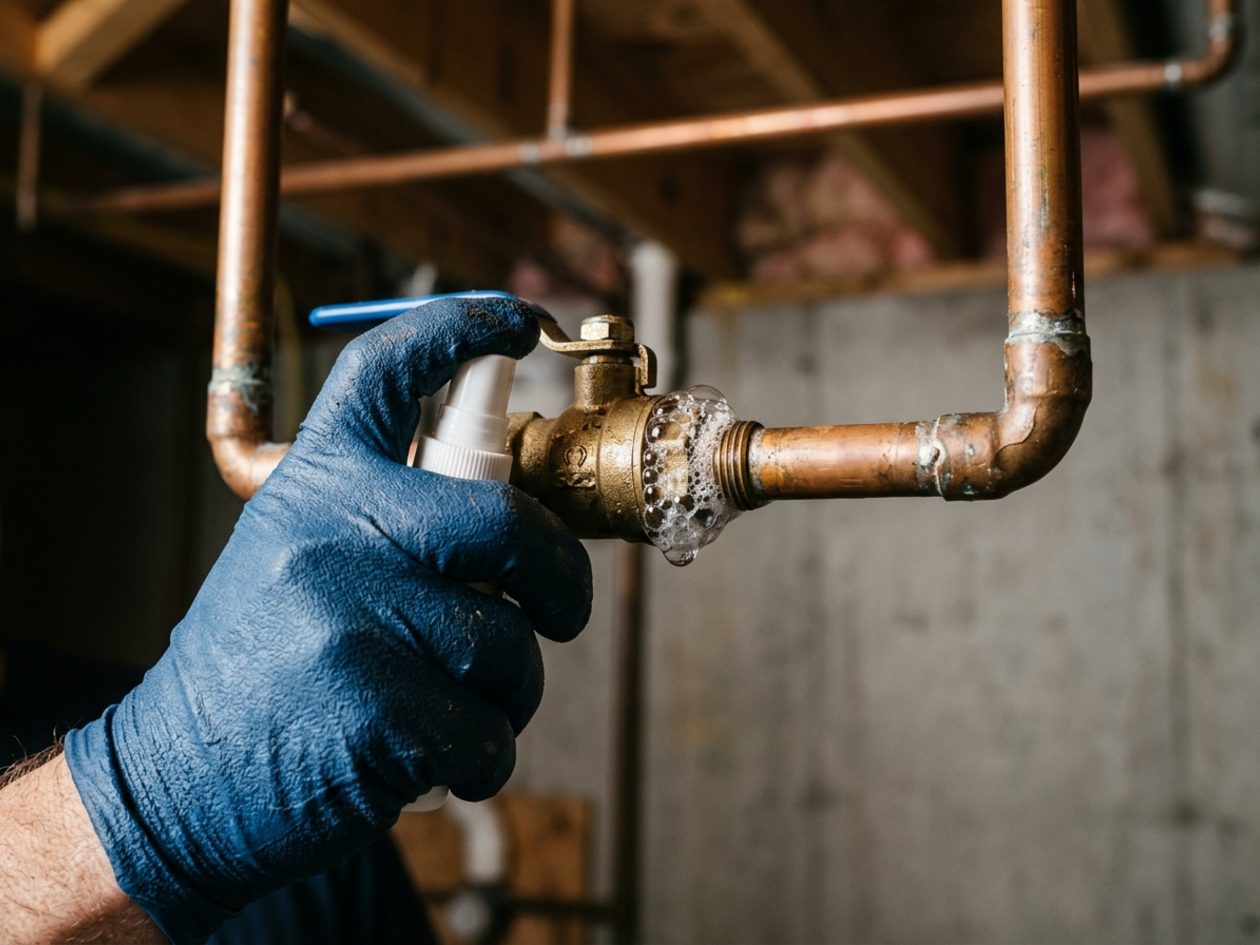 Twelve inches minimumA PVB installed below the highest sprinkler head fails inspection regardless of how well it tests.
The tester arrives with a differential pressure gauge that has been calibrated within the last twelve months, districts check calibration dates and will reject a report from an out-of-date gauge. We close the downstream shutoff, hook three hoses to the test cocks on the assembly, and bleed air out of the gauge lines. Everything after that is reading numbers.
On an RPZ we are checking three things: that check valve one holds at least five PSID above the relief valve opening point, that check valve two holds at least one PSID, and that the relief valve opens before the differential drops to two PSID. On a PVB we check that the air inlet opens at one PSID or more and the check valve holds at one PSID or more. Those numbers are set by the manufacturer and enforced by the district; there is no judgment call and no partial credit.
If the assembly passes, you get the report and so does the water district, usually the same day. If it fails, we tell you on the spot what failed and what it takes to fix it, and in most cases we can rebuild it during the same visit rather than booking a second trip and letting your compliance deadline slide.
Expect the water to be off to that zone for the length of the test. On an irrigation PVB that means nothing. On a building RPZ feeding a kitchen or a boiler, we schedule around the hours that matter to you.
Most rebuild kits are on the van. Failed today, passing today.
Calibration date matters Districts reject reports from gauges more than twelve months out of calibration. Ask any tester for theirs.
Backflow assemblies fail for boring, mechanical reasons. Knowing which one you are looking at tells you whether it is a twenty-dollar rubber kit or a full replacement.
Our water carries sediment, especially after a main break or hydrant flushing. A single grain holding a check valve open drops the differential below spec. Often cleared by cleaning and reseating during a rebuild.
Discs and o-rings go stiff with age and chlorine exposure. They stop sealing at low differentials first, which is why an assembly can pass one year and fail marginally the next.
A PVB left charged over winter cracks its bonnet or splits the body. This is the single most common failure on residential irrigation here, and it is entirely preventable with a proper autumn blowout.
The relief valve spring on an RPZ fatigues. The device starts weeping from the relief port under normal pressure, a puddle that appears without a leak anywhere else.
Debris in the relief path keeps the port cracked open. You lose water continuously and the assembly cannot hold its required differential.
A PVB below the highest head, or an RPZ mounted with no clearance for the relief port, fails inspection on sight even if every valve inside is perfect.
Most failures are rebuildable. A rebuild means disassembling the body, replacing the check discs, springs, o-rings and the relief valve components with the manufacturer’s kit for that exact model, then retesting. It costs a fraction of a new assembly and is what we attempt first on any device that is structurally sound.
Replacement makes sense in three situations. First, a cracked or split body, almost always freeze damage, cannot be rebuilt at any price. Second, obsolete models: some assemblies from the eighties and nineties no longer have parts kits available, and hunting one down costs more than a new device. Third, an assembly that has been rebuilt twice and failed again inside two years is telling you the body seats are worn past the point where new rubber helps.
There is a fourth case worth naming: an assembly that is the wrong type for the hazard. We occasionally find a double check valve protecting a connection the district now classifies as high hazard, usually because the building’s use changed. That is a replacement with an RPZ, and it is better to find out during a scheduled test than during a district audit.
Whichever way it goes, we quote before we start. Nobody gets a rebuild invoice they did not agree to.
Rebuild kits carried for common Watts, Febco, Wilkins and Zurn models.
The legal responsibility sits with the property owner, not the tester. That surprises people. The water district sends you a notice, you are required to have the assembly tested by someone the district accepts, and you are required to make sure the report reaches the district by the deadline on that notice. A tester who runs the test and hands you a form has done half the job.
We file for you. The report goes to the district in the format they accept: several around here now take electronic submission through a compliance portal, others still want a signed paper copy, and you get a copy for your own records. If you manage several properties, we can keep the whole schedule and remind you before each anniversary rather than after.
Miss the deadline and the consequences escalate on a schedule the district publishes. First comes a second notice. Then a late fee. Then, on the timeline set by local ordinance, the district has the authority to shut off water service to the property until a passing test is on file. That last step is rare, but it is real, and it happens to landlords and small commercial buildings more often than to homeowners simply because nobody in the building sees the mail.
If you have already received a second notice, say so when you call. We prioritize pages that are against a deadline.
Nearly every residential backflow failure we repair in Greeley traces back to a single October night. The sprinkler system was shut off but not blown out, or it was blown out but the PVB was left with water trapped in the body, and the first hard freeze split the brass.
The correct sequence is: shut the isolation valve, open both test cocks on the PVB to drain the body, leave the ball valves at forty-five degrees so no water sits against a closed seat, and blow the lateral lines out with compressed air. A wrapped insulating cover helps at the margins but does not save an assembly still full of water, brass conducts cold straight through fabric.
If your system was winterized by someone else, it is still worth checking the test cocks in the spring before you charge the line. A cracked bonnet often looks fine until pressure hits it, and then you have a fountain in the front yard and a repair on the clock.
We handle winterization and spring startup as well, which means the same crew that tests your assembly is the crew responsible for it surviving the winter.
One October night Most PVB replacements we sell were caused by a blowout that never happened, or one that skipped the test cocks.
Most districts around Greeley send annual notices in the same handful of weeks each spring, which means every backflow tester in the county gets called at once. Book early and the test happens on a morning that suits you; book in the last two weeks before your deadline and you take whatever slot is left.
If you are a property manager with more than three assemblies, ask about a scheduled route: we test them all in one pass, file the reports together, and put the next year on the calendar before we leave.
Compressed-air winterization that actually drains the backflow assembly, not just the lateral lines.
See details →Spring charge-up, head repairs and leak checks, the natural companion to your annual test.
See details →High street pressure shortens the life of every valve in the house, backflow assemblies included.
See details →Frost-free sillcocks and vacuum breakers, repaired before the next freeze finds them.
See details →Service line work from the meter in, including the shutoffs your assembly depends on.
See details →A weeping relief port and a hidden line leak look identical on the water bill. We find out which it is.
See details →Irrigation on almost every lot, and a district deadline that catches new owners out.
Area details →The town files its own notices, so the deadline rarely matches a neighbor’s.
Area details →Newer systems, first tests, and owners who have never had a notice before.
Area details →Assemblies sitting in shallow boxes that need checking as well as testing.
Area details →Not on the list? We cover Greeley, Weld County and the northern Front Range, see every service area.
Once every twelve months for virtually every testable assembly in the Greeley area, and that is set by local ordinance rather than by us. Some higher-hazard commercial connections are on a shorter cycle. Your water district’s notice states your deadline; if you cannot find it, we can usually confirm the anniversary date from the last filed report.
About twenty minutes at a residential irrigation PVB, and thirty to forty-five at a commercial RPZ once access, isolation and paperwork are counted. Water to that connection is off for the duration, which is why we schedule commercial tests around your business hours rather than ours.
We tell you immediately what failed and what it costs to fix. Most failures are rebuildable with a manufacturer’s kit, and we carry kits for the common Watts, Febco, Wilkins and Zurn models, so a failed assembly is often repaired and retested in the same visit. Only the passing test gets filed; a failure does not go on your record as long as it is corrected within the district’s window.
Not usually, as long as we can reach the assembly and the isolation valves. Most residential PVBs are outdoors and accessible. For an indoor RPZ in a mechanical room we need someone to let us in. Either way we will confirm access when you book so nobody wastes a trip.
We do. The legal responsibility for filing sits with you as the property owner, which is why we take it off your hands entirely: the report goes to the district in whatever format they accept, and you get a copy for your records the same day.
A straightforward residential irrigation test is one of the least expensive visits we make. Commercial RPZ testing costs more because the assemblies are larger and access is slower. Rebuilds and replacements are quoted separately and always before any work starts. Call for a current figure for your assembly type.
Yes, and usually a specific one. Water spitting from the air inlet on a PVB while the system runs means the poppet or its seal is not closing. Water weeping from an RPZ relief port means a check valve is fouled or a spring has weakened. Neither is normal, both are usually rebuildable, and both mean the assembly is not currently protecting anything.
Sometimes. If the freeze cracked only the bonnet, a new bonnet and rebuild kit can save it. If the body itself is split, and on a badly frozen PVB it usually is; there is no repair, and the assembly is replaced. We can tell you which within a few minutes of taking the top off.
Almost certainly yes. Notices go astray, especially at rental properties and at addresses where the billing contact has changed. The requirement attaches to the connection, not to whether the letter arrived. If you have a testable assembly, assume you are on an annual cycle and let us confirm your date.
In the autumn, yes, and it is the efficient way to do it. We test the assembly, file the report, then blow the system out and drain the backflow body properly so the device survives to next spring. One trip, one bill, and the two jobs that most often go wrong together get done by the same person.
Talk to a tester, not a call center.
Testing, on-the-spot repairs and the paperwork filed for you.
(970) 973-0235Answered 24 hours a day, seven days a week, every week of the year.