Grease and cooking oil
Liquid going in, solid twenty feet down the line where the pipe runs cold. The single biggest cause of kitchen branch blockages we clear, and no disposal on the market changes that.
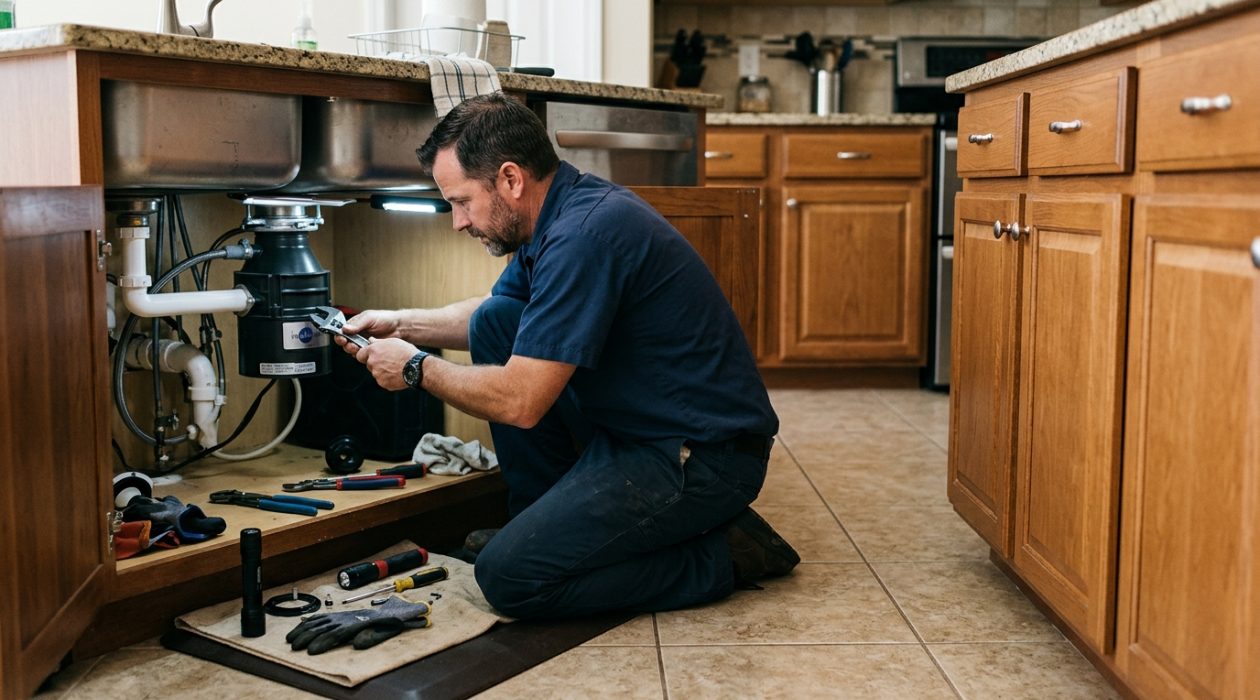
A disposal that hums, leaks into the cabinet or backs up into the other basin is usually a thirty-minute problem. The mistake is running it repeatedly and turning it into a bigger one.
(970) 973-0235If your disposal is humming and not turning, stop pressing the switch. That hum is the motor drawing locked-rotor current against a jammed plate, and every few seconds of it puts heat into windings that are not moving air. A jam you could have cleared in five minutes becomes a burnt-out motor and a replacement unit.
Switch it off at the wall. If it is on a plug inside the cabinet, unplug it. If it is hardwired, kill the breaker. Never put a hand into the chamber under any circumstances, even with the power off: the shredder ring is sharp regardless of whether it is spinning, and there is often glass or a metal fragment in there, which is why it jammed.
From there, the diagnosis is usually short. A hum means power is reaching the motor and something is stopping it. Silence means power is not reaching the motor, or the motor is finished. A leak means a seal or a fitting, and where the drip lands tells you which one. Water backing into the other basin means the drain, not the disposal.
Any of those four we can sort in a single visit. What we would rather avoid is arriving to find a fried motor that started as a chicken bone.
Describe the noise on the phone and we will tell you what to expect.
It hums but will not turn. The flywheel is jammed. Classic causes are a bottle cap, a bit of cutlery, a fruit pit, or a build-up of fibrous material wound around the impellers. The fix is to cut power, free the plate with a hex wrench in the socket underneath, remove whatever caused it, and press the red reset button on the base. If the plate frees but the unit still hums, the motor start winding has likely gone.
It does nothing at all. Work outward: reset button, then the breaker, then the switch, then the outlet inside the cabinet. Disposals trip their internal overload constantly and the reset button solves a genuine share of dead units. If power is confirmed at the unit and there is no hum, the motor is done.
It leaks. Where matters. From the top rim means the sink flange seal has failed. From the side means the dishwasher inlet or the discharge elbow gasket. From the very bottom of the housing means the internal seal has gone and water is inside the motor casing, that unit is not repairable and should be replaced.
It backs up into the other basin. Nine times out of ten the disposal is fine and the branch drain is blocked past the tee. Grinding more waste into a blocked line only compacts it.
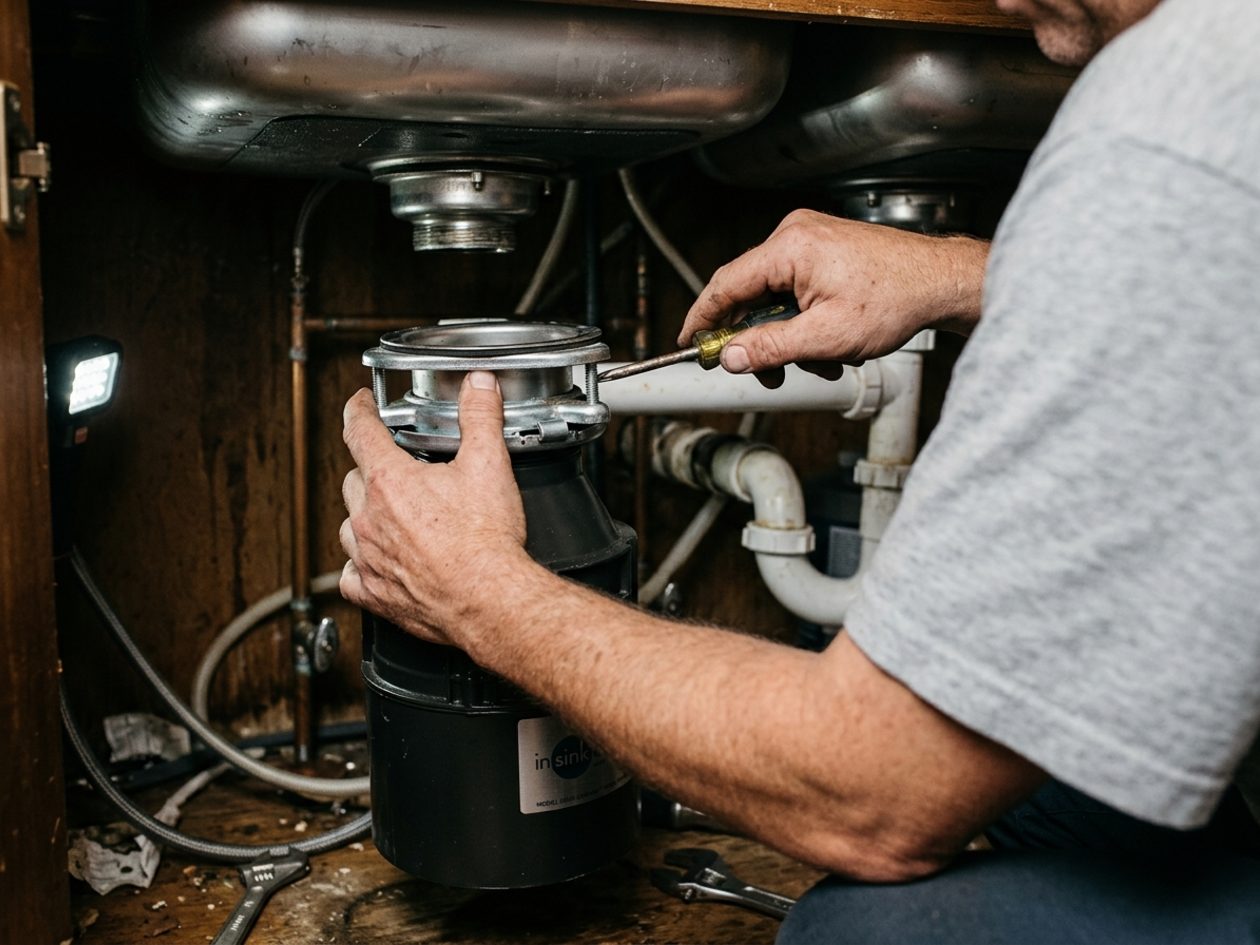 Bottom socket, then resetFreeing the plate with the hex key and pressing the red reset clears a large share of dead-sounding units.
The most common disposal leak in Greeley homes is not the unit at all; it is the sink flange the unit hangs from. The flange is bedded in plumber’s putty against the underside of the sink and clamped by a mounting ring. Over years the putty dries, shrinks and loses its grip, and water begins tracking down the outside of the disposal body.
That is why so many of these leaks are misdiagnosed. The drip appears at the bottom of the unit, so people conclude the housing has failed and buy a new disposal, then the new one leaks in exactly the same place, because the flange was never reseated. If water is running down the outside of the casing rather than emerging from the seam at its base, the flange is the suspect.
The correct repair is to drop the unit, scrape the old putty off both the flange and the sink, roll fresh putty, reseat, and torque the mounting ring evenly. It takes half an hour and it lasts another decade. On stainless sinks with thin decks we sometimes use a silicone bead instead, which flexes better.
The other repairable leaks are the discharge elbow gasket, which flattens with age, and the dishwasher inlet nipple, which is often overtightened at install and cracked. Both are inexpensive parts.
We find the source before quoting a replacement.
Water on the outside of the casing That is a flange leak, not a failed unit. Replacing the disposal will not fix it.
Modern disposals grind more than people expect, but the drain line downstream of them has not changed since the house was built. Most disposal failures are really drain failures.
Liquid going in, solid twenty feet down the line where the pipe runs cold. The single biggest cause of kitchen branch blockages we clear, and no disposal on the market changes that.
They grind perfectly and then settle into a dense sediment in the trap and horizontal run, building a plug that behaves like wet sand.
Celery strings, corn husks, artichoke leaves and onion skins wrap around the impellers rather than shredding, and bind the plate.
Pasta, rice and potato peel expand with water and turn into a paste that coats pipe walls. Peels in particular form a gluey mat over the drain opening.
A small chicken bone usually survives. A pork chop bone or a peach pit jams the plate and can chip the impellers. This is the classic hum-and-stop call.
Cold water keeps fats solid so they get shredded and carried away. Running the unit dry, or shutting the tap the instant it clears, leaves debris sitting in the chamber.
Disposals are inexpensive appliances with a service life of roughly eight to fifteen years depending on quality and use. That economics shapes the repair decision more than anything mechanical.
Worth repairing: jams of any kind, a tripped overload, a failed flange seal, a leaking discharge elbow or dishwasher nipple, a broken splash guard, a stripped mounting assembly. All of these are cheap parts and short labor on a unit that is otherwise sound.
Not worth repairing: any leak coming from the seam at the very bottom of the motor housing, because the internal shaft seal has failed and water is in the motor. A unit that hums with a freely turning plate, because the start winding is gone. A unit that trips the breaker rather than its own reset, which means a short. In all three the motor is the failure, and a replacement motor costs more than a whole new disposal.
Age is the tiebreaker. On a twelve-year-old half-horsepower builder unit with a cracked splash guard and a weeping elbow, we will tell you honestly that a new three-quarter-horsepower unit with a stainless grinding chamber is the better spend: quieter, faster, and another decade of life.
We stock replacements and can usually swap one out in the same visit as the diagnosis.
Repair and replacement quoted side by side.
If you are replacing, three specifications matter and the rest is marketing. Horsepower is the obvious one: a third-horsepower unit is builder-grade and struggles with anything fibrous; a half is the practical minimum for a household that cooks; three-quarters is the sweet spot for most Greeley homes; a full horsepower is worth it for large families and heavy use.
The grinding chamber material matters more than the horsepower number for longevity. Galvanized chambers corrode; stainless does not. On our water, a stainless chamber is the difference between a unit that dies at eight years and one that reaches fifteen.
Sound insulation is the specification people underestimate and then regret. Cheap units are genuinely unpleasant in an open-plan kitchen. Insulated models with a rubber baffle and a jacketed body run noticeably quieter, and the price difference is small relative to how often you hear it.
Two practical notes. Continuous-feed units are the standard here; batch-feed units, which only run with a stopper in place, are safer if you have young children and are worth considering. And if your sink is stainless and thin, a heavier disposal wants a proper mount, hanging a full-horsepower unit off a flimsy deck flexes the sink and eventually reopens the flange leak you just fixed.
Every new disposal ships with the dishwasher inlet blanked off by a molded knockout plug inside the nipple. If a dishwasher is going to drain through the disposal, that plug has to be punched out with a screwdriver and, critically, the loose disc has to be fished out of the chamber.
Miss the knockout entirely and the dishwasher cannot drain: it fills, stops mid-cycle, and standing water sits in the tub. Punch it out but leave the disc inside and it eventually finds the impellers, which is a jam and sometimes a chipped plate.
The other half of this connection is the high loop. The dishwasher drain hose must rise up under the countertop and be secured there before dropping to the disposal inlet, so dirty sink water cannot siphon back into the machine. Many installs skip it. If your dishwasher smells or you find sink debris in the bottom of the tub, check whether that hose runs flat across the cabinet floor; that is the cause, and it is a five-minute fix with a hose clip.
We check both on every disposal we install, and we will check them on a unit somebody else fitted if you ask.
High loop, secured A drain hose lying flat on the cabinet floor lets sink water siphon back into the dishwasher.
Run cold water before, during and for fifteen seconds after every use so waste is carried well past the trap rather than parked in it. Grind a tray of ice cubes occasionally: it knocks build-up off the impellers, which the folk remedy about sharpening the blades gets right for the wrong reason.
Skip the citrus-peel trick if your unit is older; the peel is fibrous enough to bind a tired plate. And never pour caustic drain chemicals into a disposal. They sit against the metal, damage seals, and make the eventual repair genuinely hazardous for whoever opens it.
Drips, seized shutoffs and trap leaks, the rest of what lives under the same cabinet.
See details →When the backup is in the branch line rather than the unit itself.
See details →For kitchen lines glazed with years of grease that cabling only punches a hole through.
See details →If the kitchen backs up at the same time as a floor drain, the problem is further out.
See details →For cabinet water with no visible source at any joint.
See details →Overflowing sink at an unreasonable hour. Answered around the clock.
See details →Builder-grade units reaching the end of a short service life all at once.
Area details →Larger kitchens, heavier use, and units undersized for the household.
Area details →Original disposals from the era before anyone specified horsepower.
Area details →Newer kitchens where the leak is at the flange, not the motor.
Area details →Not on the list? We cover Greeley, Weld County and the northern Front Range, see every service area.
The flywheel is jammed. Cut the power at the wall or breaker, insert a quarter-inch hex wrench into the socket on the underside of the unit and work it back and forth until the plate turns freely, remove whatever caused the jam, then press the red reset button on the base. If it still hums with a freely turning plate, the start winding has failed and the unit needs replacing.
On the bottom of the unit, usually a small red or black button in the center of the base plate. It pops out when the internal overload trips. Push it firmly back in, if it will not stay in, the motor is still overheated, so wait fifteen minutes and try again.
Not usually. Leaks from the sink flange, the discharge elbow gasket or the dishwasher inlet are all inexpensive repairs on a sound unit. The one leak that is fatal is water emerging from the seam at the very bottom of the motor housing, which means the internal shaft seal has failed and water is inside the motor. That unit gets replaced.
Yes, but block the other basin’s drain first or you will just push water sideways, and never plunge after pouring chemical drain cleaner in, you risk splashing caustic liquid. If plunging does not clear it in a couple of minutes, the blockage is in the branch line and needs cabling rather than pressure.
Eight to fifteen years. Builder-grade third-horsepower units with galvanized chambers sit at the low end, particularly on hard water; three-quarter-horsepower units with stainless grinding chambers routinely reach the top of that range. Usage matters as much as quality, a household that cooks daily wears one out faster.
Depends entirely on what failed. Jams, tripped overloads, flange seals and elbow gaskets are cheap and worth fixing at any age. Motor failures are not, because a replacement motor costs more than a new unit. If a ten-year-old unit needs a motor, replace it.
Because the drain line downstream is restricted, usually with grease and coffee sediment. The disposal is grinding correctly but the waste has nowhere to go. Running it more only compacts the plug. That is a drain cleaning job, and on a badly glazed kitchen line hydro jetting is what actually restores the full bore.
Yes. Most units use one of two common mounting systems, so a new disposal frequently drops onto the existing mount in under an hour. If the mount is a different pattern we replace the flange assembly too, and we will always reseat the flange rather than reusing tired putty.
Half horsepower is the practical minimum for a household that cooks; three-quarters suits most Greeley homes and handles fibrous waste without binding; a full horsepower is worth it for large families or heavy entertaining. Prioritize a stainless grinding chamber and sound insulation over raw horsepower, both affect daily life more.
The knockout plug in the dishwasher inlet was almost certainly left in place. It is a molded disc inside the nipple that has to be punched out and then fished out of the chamber. It is a two-minute fix and one of the most common faults we find after a DIY or hurried installation.
Tell us the noise it makes, that alone narrows it to one of four problems.
Same-day jams, seals and swaps, diagnosed before anything gets sold.
(970) 973-0235Answered 24 hours a day, seven days a week, every week of the year.