Circulator pump
Moves water around the circuit. When it fails, the boiler may fire perfectly and the house still gets no heat. Usually replaceable without disturbing much else.
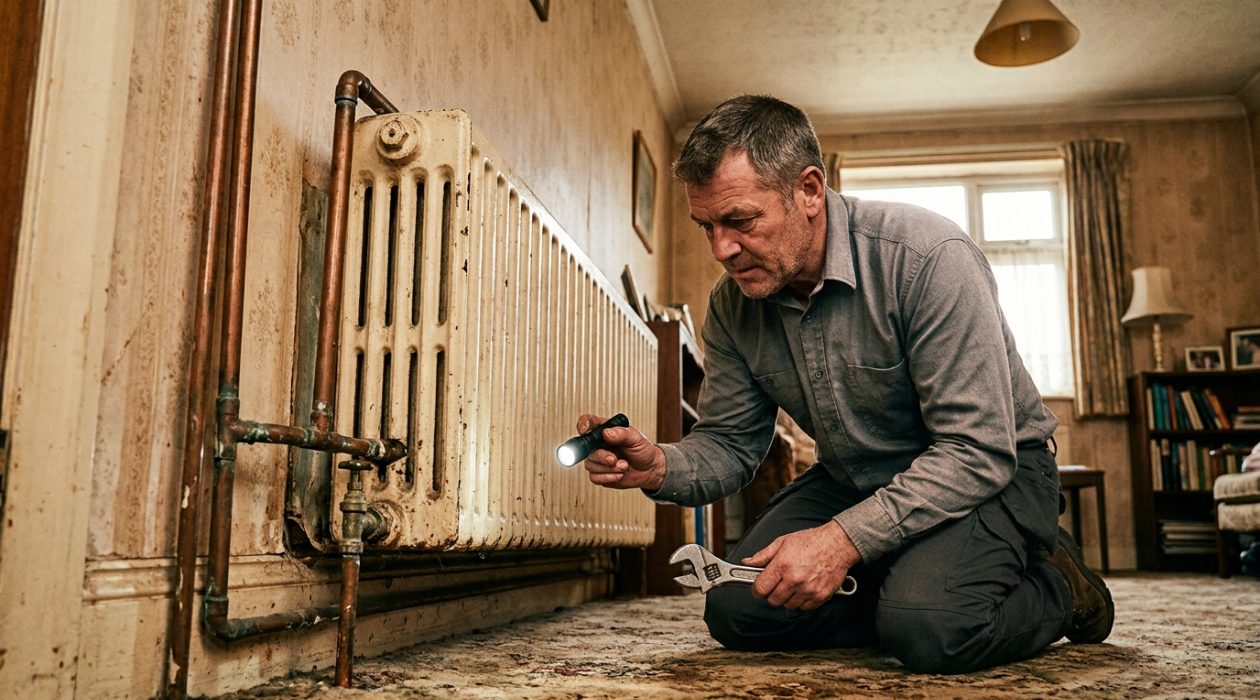
Radiators, baseboard convectors and warm floors, common in the older houses here and largely invisible until October. Circulators, zone valves, expansion tanks, pressure and the air that stops a radiator working.
(970) 973-0235Hydronic faults tend to be specific and readable, which is good news: the symptom usually points at the component.
Tell us what the pressure gauge reads cold, it narrows things down immediately.
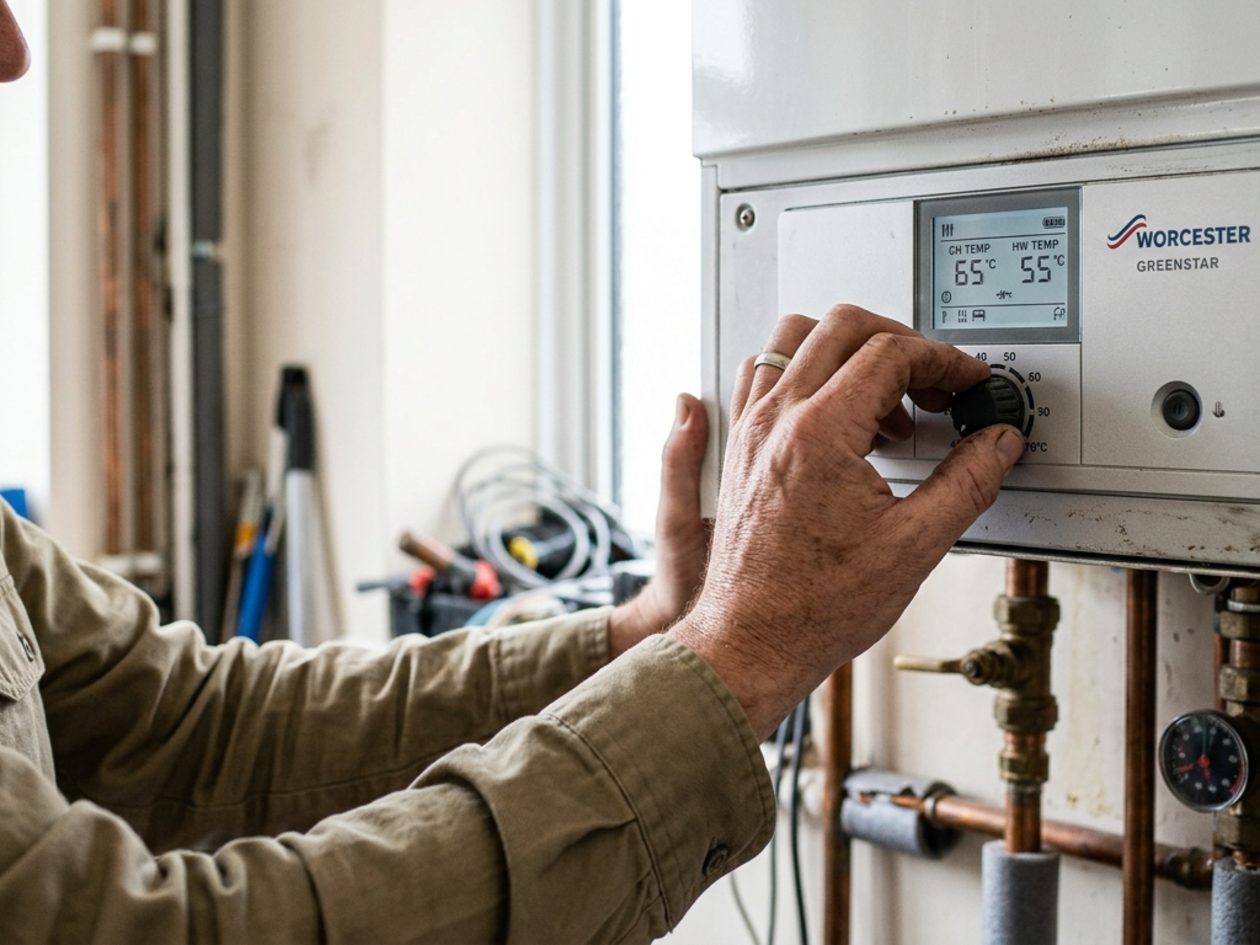 The gauge tells a storyClimbing, falling or steady, three different faults
Moves water around the circuit. When it fails, the boiler may fire perfectly and the house still gets no heat. Usually replaceable without disturbing much else.
Absorbs the volume change as water heats. A failed diaphragm means pressure spikes, a discharging relief valve, and water on the floor with nothing visibly leaking.
Direct flow to each zone on demand. A stuck valve gives you one permanently cold room, or one that heats whether you asked or not.
The system’s safety device. If it’s discharging, something upstream is wrong, and it must never be capped or plugged to stop the drip.
On radiant floors, protects the floor structure from over-temperature water. A failed mixing valve is a comfort problem and potentially a flooring one.
Decide when and how hard the boiler fires. Primitive or failing controls are a common and underrated cause of high fuel bills and short cycling.
On water quality: a hydronic system is a closed loop, and the water in it matters. Sludge: iron oxide and debris accumulated over decades: restricts flow, blocks small passages, wears pumps and reduces heat output room by room. On an old system that has never been cleaned, a proper flush and a corrosion inhibitor can restore performance more effectively than replacing components one at a time. It’s worth asking about before agreeing to anything larger.
Radiant floor heating circulates warm water through tubing in or under the floor, turning the whole surface into a gentle, quiet emitter. It’s genuinely excellent: no drafts, no noise, no cold patches, and it’s increasingly common in newer construction on the west side as well as in basement retrofits.
The reassuring part is that the buried tubing is rarely the problem. Modern cross-linked tubing is durable and, embedded in slab or plated under a subfloor, it lives a very protected life. Genuine tubing damage is uncommon and almost always traces to something mechanical: a fixing driven through it during flooring or cabinet work, most often.
What does fail is everything accessible. The manifold, where each loop is connected, balanced and isolated. The mixing valve, which blends boiler water down to a temperature the floor can tolerate. The zone actuators on each loop. The circulator. And the controls, including floor sensors and thermostats. All of those are serviceable without touching the floor.
The two symptoms worth acting on quickly: a floor that has gone cold in one zone while others work, which is usually an actuator or a blocked loop; and a floor running noticeably hotter than it should, which points at the mixing valve and can, over time, be a genuine risk to hardwood and engineered flooring above it.
Hydronic faults hide all summer. A circulator with worn bearings, an expansion tank that lost its charge, a zone valve seized in position: none of them announce themselves until the system is asked to work, and by then every technician in the county is booked.
A note on old boilers. “It’s forty years old” is not a fault. Plenty of cast-iron boilers here are sound and will outlast their replacements. Judge it on bills, parts availability and control quality, and be wary of a condensing boiler proposed for a system that was never designed to run at temperatures low enough for it to condense.
A hydronic system gives you more warning before it fails than almost any other appliance in the house, but only if somebody is looking. Three or four habits through the heating season will catch most problems while they are still a service call rather than a January emergency.
Read the pressure gauge monthly. Note what the system sits at when cold: typically somewhere around twelve to fifteen psi for a two-story house, though yours may differ, and write it on a label next to the gauge. What matters is not the exact figure but the change. Pressure that creeps up over weeks suggests a failing expansion tank or a feed valve passing water. Pressure that falls means you are losing water somewhere, and a system that quietly loses water introduces fresh oxygenated water every time it refills, which corrodes the whole system from the inside.
Listen in the first week of cold weather. Gurgling or trickling in radiators means air in the system, which is normal and easily bled. A circulator that hums, rattles or grinds is telling you about bearings, and a pump replaced on a Tuesday in October costs less and hurts less than one replaced at midnight in February.
Feel the radiators once heat is called for. Every radiator should warm from the bottom up and be hot across the whole panel. Cold at the top means trapped air. Cold at the bottom means sludge. One room that never warms while others do usually means a zone valve actuator, not a boiler problem, a distinction worth knowing before you are quoted for the wrong thing.
Look for staining. Dry white or rusty deposits around fittings, on the boiler casing or beneath the relief valve mark small leaks that have been evaporating for a while. They rarely fix themselves and they are the cheapest thing on this list to address early.
Know your shut-offs. Before the season starts, find the boiler's emergency switch, the gas valve and the isolation valves on the flow and return, and make sure everyone in the house knows where they are. In a genuine leak that knowledge is worth more than anything else here.
Write your normal cold pressure on a label by the gauge, the change is what tells you something.
Domestic hot water, including indirect tanks off a boiler.
See details →System fill pressure and the valves that control it.
See details →What happens when a hydronic house loses heat in a cold snap.
See details →Old houses with old pipe, often the same houses with boilers.
See details →Supply and sediment traps for gas-fired equipment.
See details →No heat in a hard freeze, at any hour.
See details →Pre-war houses still on original hydronic loops and cast-iron radiators.
Area details →Converted single-family homes where the boiler now serves more units than it was sized for.
Area details →Mid-century boiler installs reaching the end of a second heat exchanger.
Area details →Farmhouses on boilers with no service record and no shutdown plan.
Area details →Not on the list? We cover Greeley, Weld County and the northern Front Range, see every service area.
Look at what delivers the heat. A boiler heats water and sends it through pipes to radiators, baseboard fin-tube convectors, or tubing embedded in a floor slab. A furnace heats air and blows it through ducts to vents. If your rooms have cast-iron radiators, low baseboard units with fins behind a cover, or warm floors and no visible supply vents, you have a hydronic system. Plenty of older Greeley houses: particularly in the historic core and around Lincoln Park: were built with them, and many still run on them.
Air, usually. Air collects at the highest points of a hydronic circuit and displaces the water that should be there, so a radiator warms at the bottom and stays cold at the top. Bleeding the trapped air out through the valve at the top of each unit usually fixes it. If a single room stays cold after bleeding, the cause is more likely a stuck zone valve, a failed thermostatic head, a partly closed balancing valve, or sludge restricting flow through that particular loop.
Most residential systems sit somewhere around 12 to 15 psi cold, rising modestly when hot, but the correct figure for your system depends on the height of the building and the design, so treat the manufacturer’s plate and the installer’s marking as the authority rather than a general number. What matters more is the pattern. Pressure that keeps climbing points at the expansion tank or the fill valve. Pressure that keeps falling points at a leak somewhere in the circuit, and a system topped up repeatedly is losing water somewhere you haven’t found.
Water expands as it heats, and a sealed hydronic circuit has nowhere to put that extra volume. The expansion tank contains a cushion of air behind a diaphragm that absorbs it. When the diaphragm fails or the air charge is lost, pressure spikes on every heating cycle, the relief valve discharges to protect the system, and you find water on the floor with nothing apparently leaking. It’s a common fault, a modest part, and one of the first things a competent technician checks.
Air in the system is the most frequent cause, and it usually announces itself as a gurgling or trickling sound. Beyond that: worn bearings producing a rising whine, a seized or partly seized rotor, cavitation from low system pressure, or debris and sludge in the impeller. Circulators are generally serviceable or replaceable without disturbing much else, and catching a noisy one early is far cheaper than being without heat in January when it finally stops.
Annually, before the heating season, and hydronic systems reward it more than most equipment because so much of what goes wrong develops slowly. A service covers combustion and venting, pressure and the expansion tank, the relief valve, circulator operation, zone valves and controls, water quality and sludge, and bleeding air from the circuit. Skipping it typically means discovering a fault on the first genuinely cold night, which is precisely when everyone else is discovering theirs too.
Tubing embedded in or beneath a floor, circulating warm water so the floor itself becomes the heat emitter. It’s comfortable, quiet and efficient, and the tubing itself is generally very durable. Most faults are not in the buried tubing at all but at the manifold, in the mixing valve that protects the floor from over-temperature water, in a zone actuator, or in the controls. Those are all accessible. Genuine damage to embedded tubing is uncommon and usually traces to a fixing driven through it during other work.
Yes, and many do. Either through an indirect tank: a well-insulated cylinder heated by a dedicated boiler zone, which is efficient and gives good recovery, or through a tankless coil inside the boiler itself, which is simpler but generally weaker on capacity and more vulnerable to scaling in hard water. In this area scale is a real consideration for tankless coils specifically, and an indirect tank is usually the more robust arrangement.
Sometimes, and rarely for the reasons advertised. Old cast-iron boilers are frequently still sound and their heat exchangers can outlast several generations of modern equipment, so “it’s old” is not a diagnosis. The real questions are efficiency against your actual bills, whether the controls are primitive enough to be wasting substantial fuel, whether parts are still obtainable, and whether the system layout and emitters suit a modern condensing boiler, which needs lower water temperatures to condense at all. A replacement fitted to a system designed for high-temperature operation often disappoints.
A few safe things. Confirm the power switch and breaker, since boilers often have a service switch that looks like a light switch nearby. Check the thermostat and its batteries. Look at the system pressure gauge, many boilers lock out on low pressure. Look for a reset button and press it once. If it locks out again, stop: repeated resetting on a combustion appliance masks a fault that exists for a reason. And if you smell gas, leave the house, call the gas utility from outside, and don’t touch switches.
Radiators, baseboard or warm floors? And what does the pressure gauge read?
Boiler, radiator and radiant floor service across Greeley, Evans, Windsor and the Weld County communities.
(970) 973-0235Answered 24 hours a day, seven days a week, every week of the year.